Maine high school baseball implementing new safety rule next season
By Larry Mahoney, Bangor Daily News Staff
High school baseball in Maine will undergo some rule changes next season, including either a double first base or a larger first base bag.
The change was recommended by the National Federation of State High School Associations Rules Committee and approved by the NFHS Rules Review Committee and NFHS Board of Directors.
Current first base bags used in Maine high school baseball are 15 inches square, but, beginning next spring, they can have one base that is 18 inches square or they can use two 15-inch bases, one in fair territory and one in foul territory.
The double first base has been used in Maine high school softball for several years and was introduced in Division I college softball recently.
“Both options are designed to reduce the potential for collisions at first base and support a reduced risk playing environment without changing the fundamental nature of the game,” said Elliot Hopkins, the director of sports and the liaison to the NFHS Baseball Rules Committee.
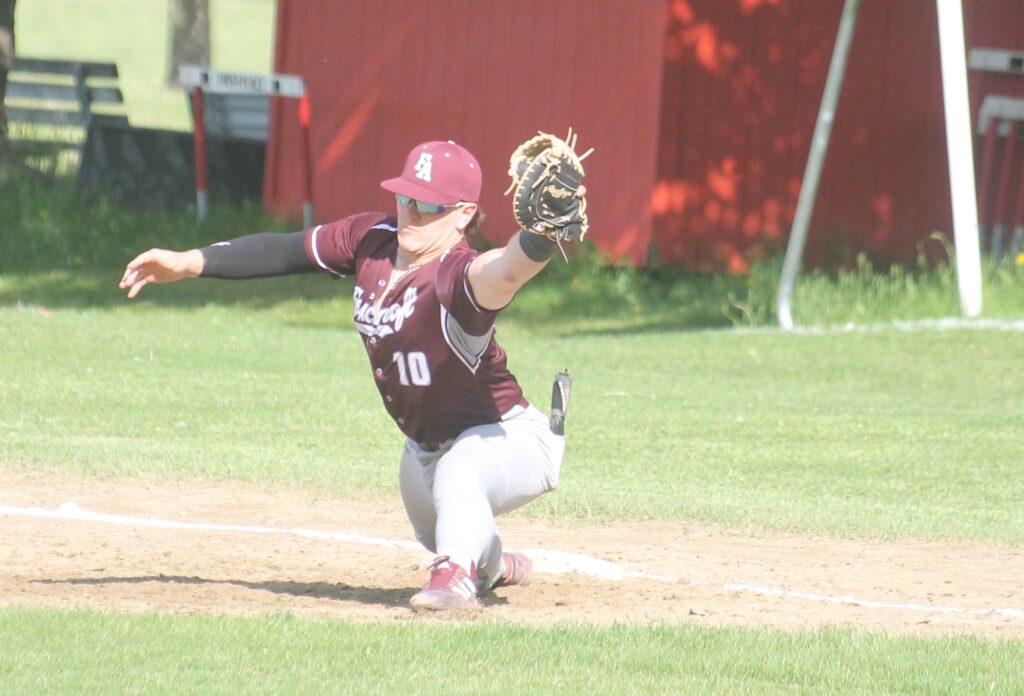
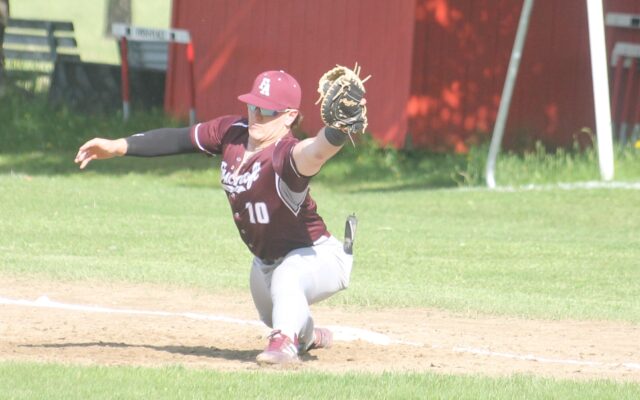
STRETCH FOR THE OUT — Foxcroft Academy’s Thomas Day stretches for the out at first to start the bottom of the fifth inning of a game at Central High School of Corinth in 2025.
University of Maine head baseball coach Nick Derba said in some of their road games this past season, a double-first base was implemented.
He said that he wasn’t enamored with the double first base idea initially, but he admitted that there were definitely instances where collisions were avoided by it.
George Stevens Academy of Blue Hill baseball coach Danny Kane and Lee Academy coach Randy Harris, who both completed their 38th seasons with their respective teams, have a similar sentiment to Derba.
Both said they consider themselves traditionalists, but that they completely understand the rationale behind it.
“Being old school, I don’t think it’s necessary but safety is the thing they’re concerned about. I’ve watched it at the younger age levels and it doesn’t seem to be detrimental. I’ll adjust over time,” said Kane.
“I’m not really happy with it, but I understand the reasoning is safety,” said Harris. “I’ve played and coached my whole life and had just one first base [bag]. I haven’t seen a whole lot of injuries or collisions at first base ,but they are doing it for safety reasons, and they are doing it in Division I, so if it’s good for college, it must be good for high school.”
“I’m surprised they’ve waited this long,” said veteran Brewer High School softball coach Skip Estes, who has coached the Witches since 2006 and feels the double first base has prevented a number of collisions and potential injuries.
“It’s a great tool,” he added.
A potential change involves adopting the Major League Baseball extra-inning rule where a runner is placed on second base to start an extra inning if the score is tied after the regulation number of innings have been played. It will be optional next spring.
In Maine high school softball, a runner is placed at second base beginning with the 10th inning.
A regulation game is seven innings so the eighth and ninth innings are played normally.
In Major League Baseball, the runner is also put on second base to start the 10th inning, but a regulation MLB game is nine innings.
College and high school softball and Major League Baseball do not have pitch count limits, but Maine high school baseball does, so Harris and Kane are in favor of the runner-on-second rule.
“A couple of years ago, there were some 18 and 19-inning games and, because of the pitch counts, both teams burned through their entire pitching staffs,” said Kane. “So they didn’t have much left for their next game.”
Under Maine high school pitch count guidelines, pitchers have to have four days rest if they throw 96-110 pitches in a game. They have to have three days rest if they throw 66-95, two if they throw 40-65 and one if they throw 21-39.
If they throw 20 or fewer, they don’t need a day of rest before they throw again.
Kane said when he was in high school, they didn’t have pitch counts, and “we had pitchers who threw over 110 pitches in a game and then threw two days later. And a couple of those guys had arm problems later in life.”
He also noted that when you get into the 13th, 14th or 15th innings, games can get “really ugly” because you are forced to utilize seldom-used pitchers.
Kane favors waiting until the 10th inning to put a runner on second, saying he would like to see if they could decide the game in the eighth or ninth innings first.
Harris is firmly in favor of the runner-on-second rule.
“I do like that one especially being at a small school,” said Harris. “We got behind the eight-ball several times this year. We had 12 players total and a limited amount of pitchers. If you have a wet spring like we did this year, you’re playing every Monday, Wednesday and Friday. And if you have to pitch some kid an extra two or three innings, that really messes up the pitch count.”
Harris said he would be fine going to the runner-on-second in the eighth inning or playing two regular extra innings before implementing it in the 10th inning.
“In high school, we’re so limited with pitchers, whatever you can do to keep pitch counts down and be able to use more kids in games is better. Nobody wants to see a game where each team is using their number four pitchers and it winds up 17-12,” said Harris. “Maybe at a Bangor High, where they have five or six pitchers, it’s not a big deal but we had three [pitchers] we used most of the time and had to find time for a fourth one here and there.
“Anything that helps the pitch count stay down, I’m in favor of.”
Estes said if he was a baseball coach, he would be all in favor of putting a runner on second in extra innings.
“You don’t want to use up all of your pitchers in one game,” said Estes. “It’s very important.”
Mike Bisson, who succeeded the retired Mike Burnham as the executive director of the Maine Principals Association on July 1, said the MPA’s Baseball Committee would have to “adopt the option” pertaining to the extra-inning rule in order for it to be implemented next spring.
Among other rules that will go into effect include one-way communication will be allowed between the coach and the pitcher and/or catcher for the purpose of calling pitches. The catcher used to be the only one who could receive communication from the coach.
Other players cannot use electronic communication devices unless it is a medical device, and each team, when it is in the field, cannot have more than one player-to-player meeting during an inning and that is defined as having two or more defensive players involved.
Coaches will be allowed to use a handheld electronic scoring device or other scoring material while in the coach’s box.