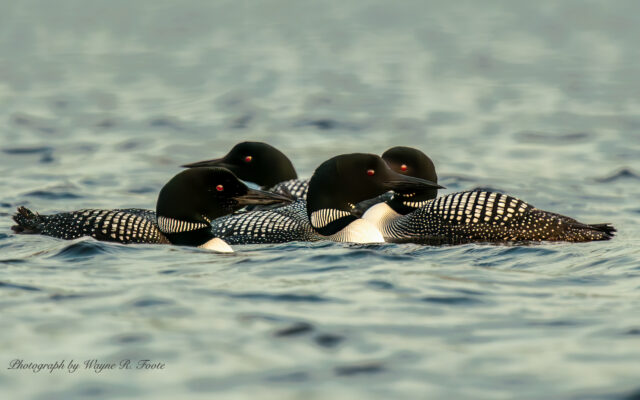
Maine Audubon’s annual Loon Count scheduled for July 18
For many people in Maine, the middle of July means one thing: counting loons! Since 1983, volunteers have been getting up early on the third Saturday of July and going out on lakes to count loons, to help Maine Audubon collect valuable data about the Common Loon population. Volunteers submit data about the number of loons they observe from 7 to 7:30 a.m., allowing Maine Audubon to assess how the number of adults and chicks has changed over the past 40-plus years.
This year, the Loon Count will take place on Saturday, July 18 on lakes and ponds all across the state. Maine Audubon is still looking for a few volunteers to count loons on specific lakes in Franklin, Hancock, Oxford and Penobscot counties (visit maineaudubon.org/looncount to see the full list). The deadline to sign up to volunteer for the Annual Loon Count is July 10, so please check the list, then email conserve@maineaudubon.org as soon as possible.
Maine has the largest population of loons in the eastern United States, which makes the breeding success of loons here critical. Last year, every single number associated with the Annual Loon Count was higher in 2025 than it was in 2024 — the number of adult loons, loon chicks, lakes counted and volunteers — and scientists at Maine Audubon say it’s a great indication that the Common Loon population is healthy here. That’s also a good indicator of clear waters, healthy fish populations, and breeding habitat to support a stable loon population.
To determine a population estimate for adult and chick numbers in the southern half of Maine (south of the 45th parallel, where enough lakes are covered by counters to produce a reliable estimate), Maine Audubon uses a survey protocol which has been in place since the count began in 1983. Based on our calculations, we estimated a 2025 population of 3,174 adults and 568 chicks for the southern half of Maine. In comparison, in 1983, when the count first began, we estimated a population of 1,417 adult loons and 176 loon chicks in the southern half of Maine, suggesting the population has more than doubled since then.
But last year’s good news doesn’t mean loons can rest easy, as plenty of threats to loons still exist. Lead poisoning from ingesting lost and discarded lead tackle is one major threat and Maine Audubon continues to work to get lead tackle out of circulation. People can always drop their lead off at Maine Audubon centers in Falmouth and Holden, or at any of the Maine Department of Inland Fisheries and Wildlife offices around the state. Maine law bans the sale and use of bare (unpainted) lead jigs and sinkers containing any amount of lead that weigh 1 ounce or less or measure 2.5 inches long or less. The sale of painted lead jigs within that small size range is also prohibited and, starting Sept. 1, the use of painted lead jigs within that small size range is prohibited.
Boat wakes also pose a threat to loons. Loons’ feet are located far back on their bodies, meaning they cannot walk on land. That means their nests are right at the shoreline, and the nests are often flooded, with eggs washing out of the nest, by boat wakes. All motor boats on Maine lakes are required to travel at no-wake speeds when they are within 200 feet of shore or islands. Boats that facilitate wake surfing create even larger waves and can impact loon nests even when operating as far as 500 to 600 feet offshore. Maine recently adopted a law specifically to address wakesurfing activity, prohibiting people “from operating a motorboat in less than 15 feet of water or within 300 feet of the shoreline when the motorboat is engaged in a wakesurfing activity.” So this summer, if you see or hear a loon on a lake in Maine, make sure you give it plenty of space!
For more information about the Maine Audubon Annual Loon Count, our Fish Lead Free program or to participate in other loon conservation efforts like monitoring nesting pairs throughout the summer or doing educational outreach in your community, contact conserve@maineaudubon.org or visit maineaudubon.org/loons.
Maine Audubon works to conserve Maine wildlife and wildlife habitat by engaging people in education, conservation and action.