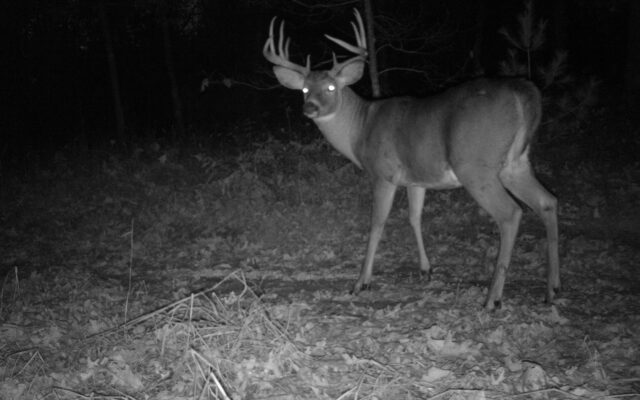
Are we losing the reasons why we hunt because of trail cameras?
By Al Raychard
The evolution of the trail camera has been extraordinary. I still own a couple collecting dust somewhere that date back to the late 1980s.
They ran on several C-cell batteries and captured photos on 35mm Kodak or Fuji film, whichever you could find or was cheapest. Other than the batteries that always seemed to die in cold weather and the cost of film and development, they were easy to use and took decent photos.
SD cards and digital technology replaced film in the 1990s, adding infrared sensors for nighttime images and video, and eventually a host of other features.
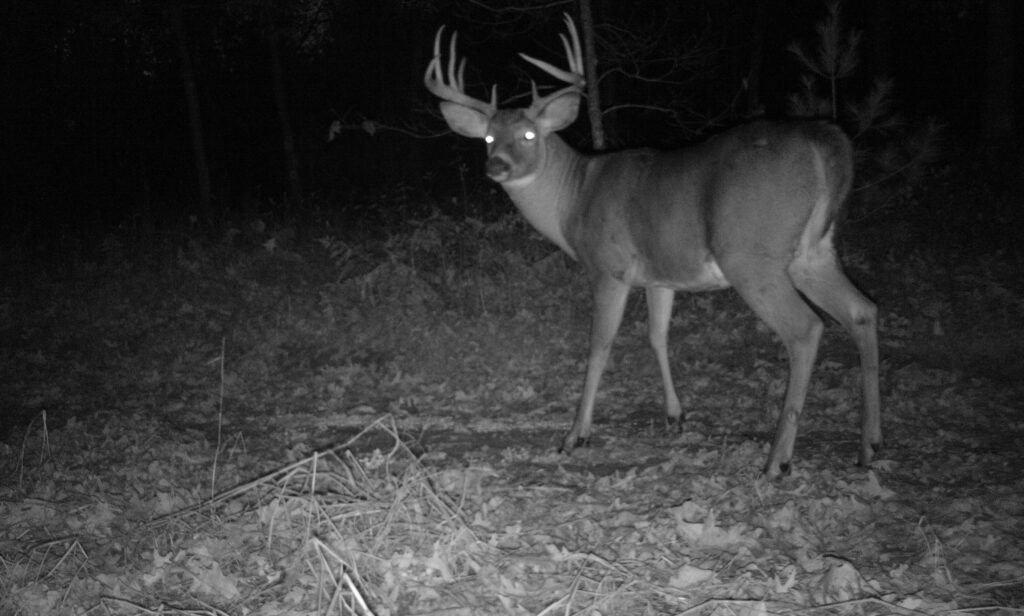
BUCK PICTURE — The author captured this buck on his trail camera.
It was a good thing, because just about everything went digital around that time. Finding 35mm film — or even a place to get it developed — seemed to become almost impossible overnight.
Since then, game cameras — trail cameras or whatever you choose to call them — have continued to evolve. Perhaps too fast and too far for non-techies like me.
Some units have so many menu settings and features it seems a college degree is needed to understand them all.
Solar-powered, cellular, live-streaming and Bluetooth-compatible models have made game cameras more sophisticated than most hunters ever imagined. One has to wonder where it will end.
My guess is it won’t end as long as game cams remain popular. Official statistics are hard to find, but a 2010 survey by the Quality Deer Management Association, now the National Deer Association, showed those polled owned three to five trail cameras. About 14 percent owned five to 10.
The poll is old and small, but I’d wager game cameras are at least as popular today. I’d even guess a high percentage of hunters — perhaps a majority — can’t hunt without them.
Whatever the numbers, the rise of game cams has raised fair chase and privacy questions. Cameras that require a physical check are generally accepted, but cellular models have been declared a violation of fair chase standards by Pope and Young and Boone and Crockett. The Longhunter Society, which keeps trophy muzzleloading records, follows similar guidelines.
Regulations are also catching up. Arizona banned all hunting use in 2021. Laws now exist in Utah, Kansas, Delaware, Iowa and several other states.
Here in Maine, I wonder how many hunters know it is prohibited to “place a camera upon another person’s private land without written permission” and that “all cameras must be labeled with the owner’s name and contact information.”
I was once an enthusiastic game cam owner. Before building our home and for several years after, I put cameras out each fall, weeks before hunting season, to see what deer and other wildlife lived on or passed through our acreage.
It was exciting and informative. Over the years we got images of some respectable bucks, but I don’t think we killed a single one. The same goes for bear.
These days we rarely put out cameras during hunting season or rely on them to help fill a tag. We haven’t considered live streaming, paying for cellular service or upgrading to more sophisticated units. We see no need.
A trail camera can tell you something was there and may still be in the area, but it’s no guarantee the animal will be there when you are. Things change quickly in the woods.
If there’s one predictable thing about deer, bear and other wildlife, it’s that they are unpredictable.
Game cameras can give hunters an emotional boost, and I know there are times during hunting season when that’s important. But in the end, we still have to hunt.
I have to wonder: as hunters depend more on cameras and other gadgets to fill tags, are we losing the reasons why we hunt in the first place?
I have no issue with game cameras or anyone who enjoys them. Hunting has always evolved, and cameras are just part of that evolution. I don’t fully understand or agree with all the fair chase and ethical hoopla. To each his or her own.
If I thought a camera would make a difference, I’d be the first to dust it off and start using it again. For now, they’ll stay put. In the meantime, we’ll have to wait and see what future regulations bring.