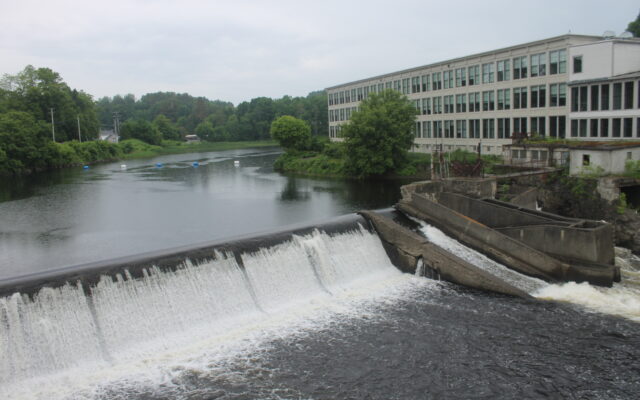
Mayo Mill Dam removal planned for 2028
DOVER-FOXCROFT — Removal of the Mayo Mill Dam on the Piscataquis River in downtown Dover-Foxcroft is anticipated to start in the spring of 2028.
This timeline is dependent on an application to surrender the Moosehead Hydroelectric license currently under review by the Federal Energy Regulatory Commission.
A year ago residents opted to remove the town-owned dam rather than fund improvements to the structure, a move that will save the town millions of dollars in repairs.
After years of research, including work by two separate dam committees, residents voted 659-297 in 2025 not to authorize the Select Board to borrow up to $9 million for the retention and repair of the dam. The Select Board was given the go-ahead to work with external partners to remove the dam.
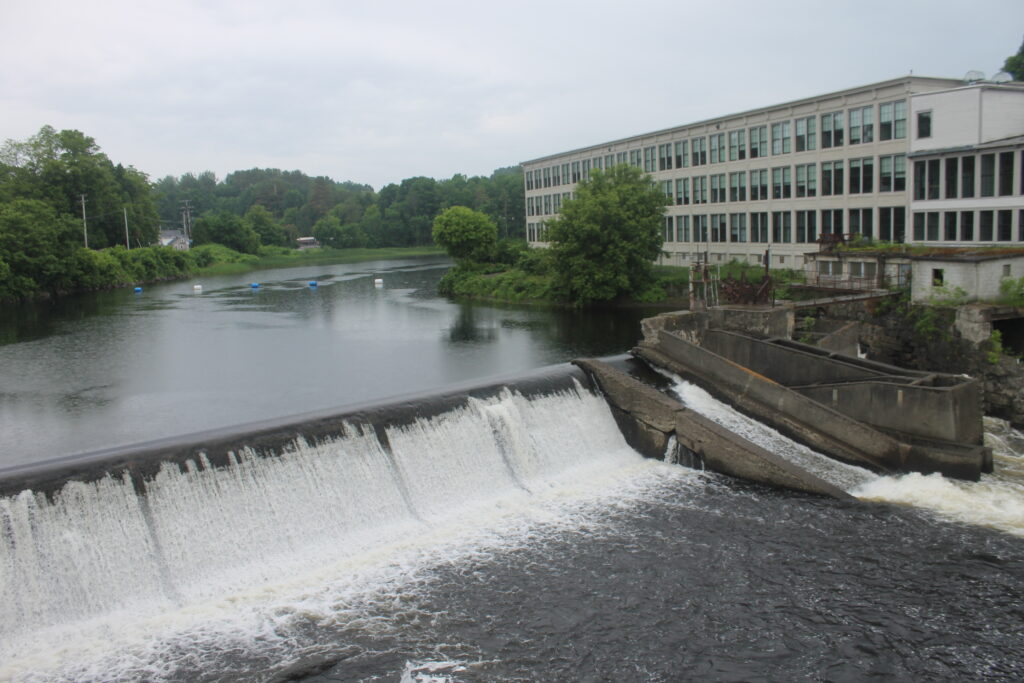
MAYO MILL DAM — The Mayo Mill Dam on the Piscataquis River in downtown Dover-Foxcroft. The scheduled timeline has removal of the structure starting in the spring of 2028.
Leaving the dam as is was not an option. The town acquired the structure after a mill closure in 2007, and it has not complied with federal regulations for more than a decade. The Federal Energy Regulatory Commission cited multiple structural deficiencies in a study. Ideas of retrofitting the dam and using it for hydroelectric power were deemed too expensive.
Had residents approved repairing the dam, the $9 million price tag would have been spread out across 25 years, with a 5% interest rate, putting the project cost at $14,107,600, including $5,107,600 in interest. The projected annual cost would have been $664,000.
“The dam is going to come out all the way to the bedrock and lower water elevation right away,” Jon Viti, Piscataquis River project manager with Atlantic Salmon Federation, said during a Monday Select Board meeting. This will help prevent future flooding in the area.
A power house will be removed. Some asbestos was found inside, but no other major chemicals were, Viti said.
Crews will also move a boat launch at Spaulding Cove near the intersection of South and Pine streets to match the narrower Piscataquis River, with the precise location to be determined, and will perform grading and sediment removal in the cove. Workers will manage vegetation for five years to ensure no invasive species have taken root.
Engineer Inter-Fluve has completed about 90% of the project design, with 100% due next month.
The Federal Energy Regulatory Commission application was submitted in May. An application to Maine Department of Environmental Protection for a permit under the Maine Waterway Development and Conservation Act was submitted in August.
The Federal Energy Regulatory Commission review takes 18-24 months.
“If everything goes on track as we anticipate, and that includes FERC review, the project could go out to bid next fall,” Eileen Bader Hall, freshwater restoration manager with The Nature Conservancy, said. This would set up construction for spring 2028.
Landowner access agreements will need to be in place and part of this includes determining who owns bits of land that have been submerged by the river for nearly two centuries.
The Select Board authorized Town Manager Alsina Breenstuhl to work with town attorney Jon Pottle, partner at Katahdin Law, to initiate eminent domain authority for the needed parcels.
The owners of record are long deceased so the town needs to make a reasonable effort to locate any heirs. This has been met with dead ends, Pottle said. Taking by eminent domain may be the best method to ensure full access to the site.
A condemnation order would describe what is being taken by the municipality. Such an order may be on the agenda for the next Select Board meeting on Monday, Sept. 28.
Residents would need to approve taking of property and compensation at a special town meeting.
“If someone comes out of the woodwork and says ‘I am an heir,’ that would be fantastic,” Pottle said, but this scenario is unlikely.