Mayo Mill Dam removal eyed for 2028
DOVER-FOXCROFT — Early next month the Atlantic Salmon Federation will submit an application to Maine Department of Environmental Protection for a permit under the Maine Waterway Development and Conservation Act for the proposed 2028 removal of the Mayo Mill Dam on the Piscataquis River in downtown Dover-Foxcroft.
The public can weigh in at https://www.maine.gov/dep/mels/hub.html for comments to be compiled for the administrative record after the application has been submitted.
The application will be submitted on or before Aug. 5. Following its submission, the DEP will formally open a public comment period. To stay informed about all upcoming opportunities for public comment, please email DEP-Hydropower@maine.gov and request to be added to an interested parties list.
The DEP requires the information meeting as part of the permit application process. An application to surrender the Moosehead Hydroelectric license is still under review by the Federal Energy Regulatory Commission, and state and federal permits for the project must be pursued simultaneously.
The DEP permit application has to be submitted within 60 days of FERC’s public notice of the surrender application, which was issued on June 5. A year ago residents opted to remove the town-owned dam, a move which will save the town millions of dollars in repairs.
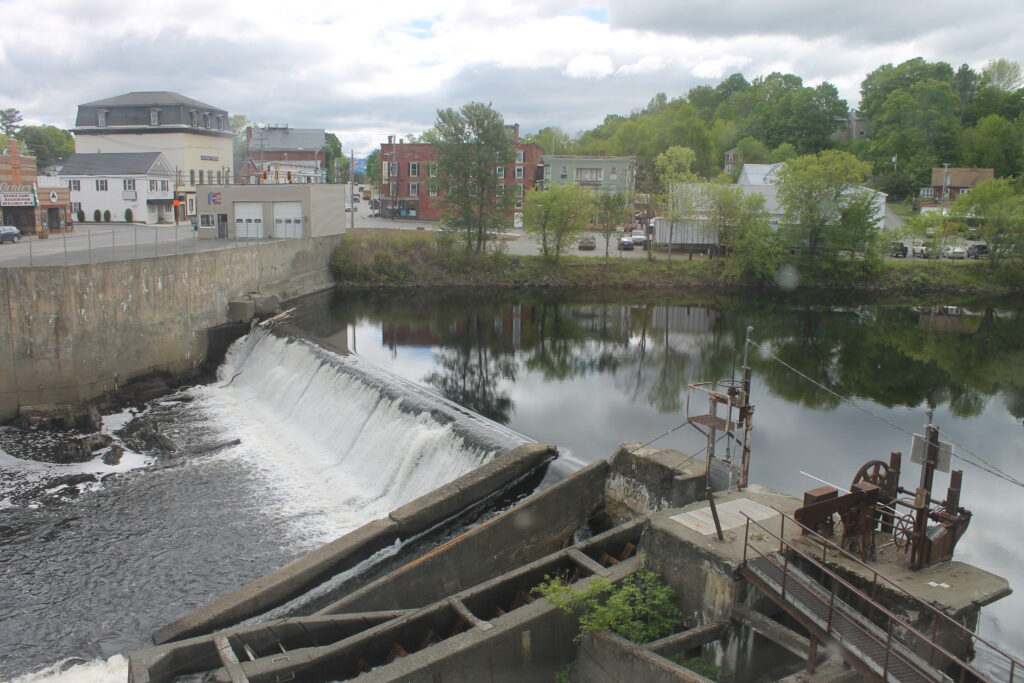
MAYO MILL DAM — The Mayo Mill Dam on the Piscataquis River in downtown Dover-Foxcroft. Permit applications are in the works for removal of the structure, which could be done in 2028.
“Therefore the MWDCA permit to DEP will be submitted on or before Aug. 5,” Town Manager Alsina Brenenstuhl said during a hearing at the town office on July 20.
“We are going to be applying for other permits as we have mentioned in the past,” Jon Viti, Piscataquis River project manager with Atlantic Salmon Federation, said. The Atlantic Salmon Federation and The Nature Conservancy are working with the town to remove the dam and restore the town’s riverfront.
Other site permits include the U.S. Army Corps of Engineers for stream alteration, state historic preservation office, Endangered Species Act, the town for demolition and shoreland zoning.
“Right now we are on schedule to do this in 2028,” Viti said about dam removal, with this timeline being dependent on the FERC surrender application.
After years of research, including work by two separate dam committees, residents voted 659-297 in 2025 not to authorize the Select Board to borrow up to $9 million for the retention and repair of the dam. The Select Board was given the go-ahead to work with external partners to remove the Mayo Mill Dam.
The dam surrender application goes to the Federal Energy Regulatory Commission, where review takes about 18-24 months.
Permitting could be complete by 2027, allowing the removal project to go to bid with work planned for summer 2028. The schedule is subject to change.
Leaving the dam as is was not an option. The town acquired the structure after a mill closure in 2007, and it has not complied with federal regulations for more than a decade. The Federal Energy Regulatory Commission cited multiple structural deficiencies in a study. Ideas of retrofitting the dam and using it for hydroelectric power were deemed too expensive.
Had residents approved repairing the dam, the $9 million price tag would have been spread out across 25 years, with a 5% interest rate, putting the project cost at $14,107,600, including $5,107,600 in interest. The projected annual cost would have been $664,000.
Work will start with the slow drawdown of the impoundment in the spring.
“Once the water levels come down that will allow them to work on the dam all the way down to the bedrock, removing the former power house,” Viti said.
A new boat launch would be constructed to match the narrower Piscataquis River. Grading and sediment removal would be done in the cove and vegetation will be managed along the river for five years to ensure no invasive species have taken root.
Dam removal will have some positive environmental impacts, Viti said. These include flood reduction and improved water quality.
“A lot of the native fish like brook trout and salmon that are coming up through here and other native fish prefer to have it well oxygenated and have cooler temperatures,” he said.
“By removing the dam, that is removing the need for ongoing maintenance that causes environmental damage,” Viti said.
A potential negative effect of removal is the release of sediment but this will be monitored to help ensure no more of the soil gets into the Piscataquis River than is anticipated. Water quality will also be monitored regularly and this has already begun.
Construction noise may disturb wildlife. Plans have been made to limit this as much as possible.
“It will still be the same amount of water moving down the river and through the river system,” Eileen Bader Hall, freshwater restoration manager with The Nature Conservancy, said. “The dams in place right now slow down the water and they artificially elevate the water level behind the dam but they are not like a dam that provides flood storage.”
The river above the dam in Guilford and below Browns Mill in Dover-Foxcroft are what the intown waterway would look like with the structure no longer in place, flowing like a river instead of being flat like a lake.
A project update is planned for the fall, potentially during a September Select Board meeting.