Maine Historical Society brings rare copy of Declaration of Independence to Foxcroft Academy
DOVER-FOXCROFT — To mark the 250th anniversary of the founding of the United States of America, the Maine Historical Society brought a rare copy of the Declaration of Independence it has had in its collection since the early 20th century to each of the state’s 16 counties to provide everyone the opportunity to see one of the nation’s most important documents.
Foxcroft Academy hosted one of 26 surviving copies of the Dunlap Broadside of the Declaration of Independence, printed in Philadelphia on July 4, 1776, and sent to the Colonies to announce American independence, from Sept. 3 to 5 during the Piscataquis County tour stop. The secondary school hosted a commemorative gathering on Sept. 4 in the Jim Robinson Field House to honor the document and its significance.
Foxcroft Academy is privileged to host the opportunity to “to view one of the most remarkable documents in our nation’s history,” Head of School Arnold Shorey said.
The Dunlap Broadside, a single piece of paper printed on one side and named for printer John Dunlap, was the first authorized printing of the Declaration of Independence. On the evening of July 4, 1776, about 200 copies were printed “so that the declaration’s words could travel quickly, be read aloud publicly and carry the revolutionary ideas of American independence throughout the colonies,” Shorey said.
“To stand in the presence of this document is to be reminded that the Declaration of Independence was not simply a statement from the past but is a bold and powerful assertion that all people possess the inherent rights,” he said, with the government deriving its just authority from the people.
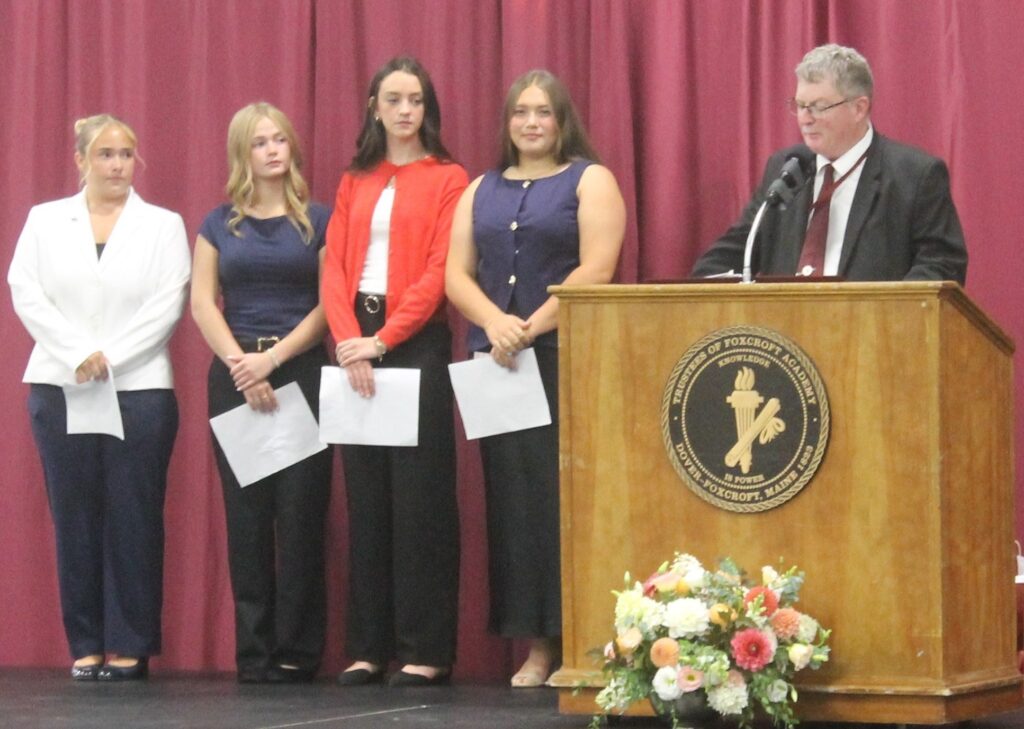
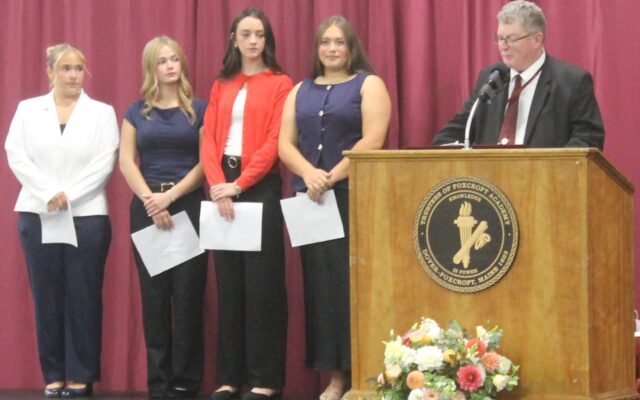
STUDENT READERS — Foxcroft Academy Head of School Arnold Shorey introduced four student leaders to read the Declaration of Independence aloud during a Sept. 4 celebration for the school hosting a copy of the Dunlap Broadside Declaration of Independence in the Jim Robinson Field House during the Maine Historical Society’s statewide tour of the document for the 250th anniversary of the nation’s founding. From left, Junior Class President Alicen Kane, Senior Class President Jadenne Frigon, Junior Class Vice President Kendall Killam and Senior Class Vice President Jasmine Hall.
“These words have challenged generation after generation to continue the unfinished work of completing a nation that lives up to these ideals,” Shorey said, with this being both an inheritance and a challenge for the nation’s young people.
“Across 250 years, our nation has faced periods of uncertainty, division, sacrifice and change,” Shorey said. “Yet the principles expressed in the Declaration of Independence, human dignity, equality and liberty and the responsibility to pursue a more just society, have endured. As challenges come and go, these ideals have been a firm guide for each new generation. Our students are not merely observers of history, they are the future stewards of our democracy. Call to lead with courage, thoughtful judgement, respect for others and a commitment to the common good.”
The program should inspire attendees to reflect on those with the courage to declare independence from England 250 years ago and all have a responsibility to live out ideals they set forth, the head of school said.
“The 250th is really an achievement for a country built on radical principles that were revolutionary in 1776 and remain so today,” Maine Historical Society Executive Director Steve Bromage said.
“It expressed soaring ideals: ‘We hold these truths to be self-evident that all men are created equal, that they are endowed by their creator with certain unalienable rights that among these are life, liberty and the pursuit of happiness.’ Those words still inspire us so deeply,” he said.
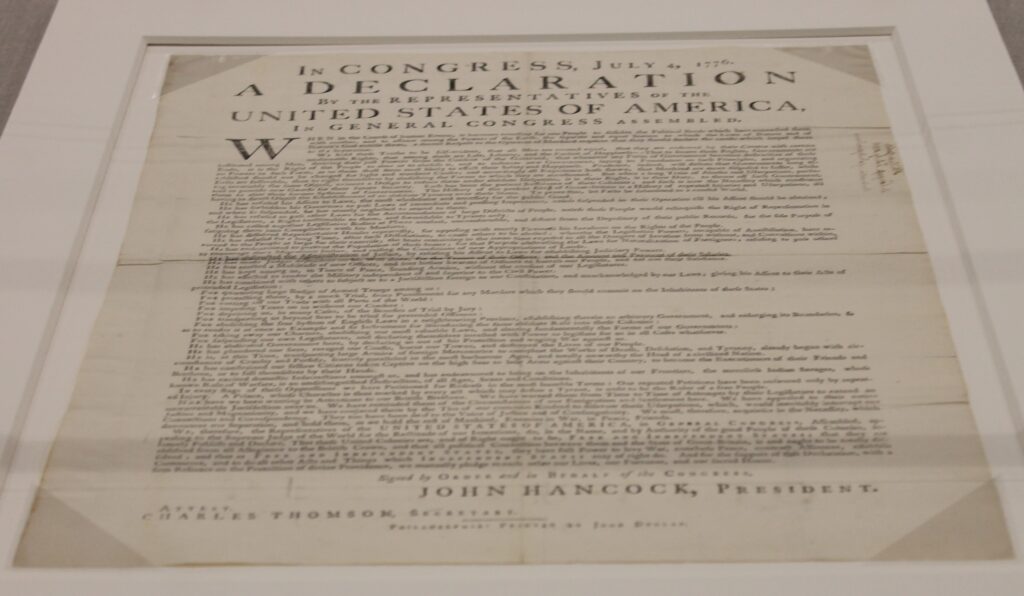
DUNLAP BROADSIDE — One of 26 surviving copies of the Broadside Dunlap Declaration of Independence, printed on the evening of July 4, 1776 in Philadelphia. The document has been in the collection of the Maine Historical Society since the early 20th century.
Bromage acknowledged the ideals were not born fully realized, becuase 250 years ago the indigenous population, people of color, women and others were denied basic rights. Achieving these is the job of Mainers and Americans.
“At Maine Historical we believe the 250th provides a tremendous opportunity for Mainers to lead, to once again demonstrate our long tradition of independent thinking, respectful dialogue and standing up for common sense values,” Bromage said. “We as Mainers can help take the lead for setting the tone for civic dialogue in this country.”
About 600 Foxcroft Academy and SeDoMoCha Middle School students passed through the field house to see the Dunlap Broadside of the Declaration of Independence.
“The level of conversation and dialogue we have heard has been so moving,” Bromage said. “Every voice and person in Maine matters, contributes and has the power to shape our country’s story,” he said “The words of the Declaration of Independence give everyone a seat at the table, that is what this 250th anniversary is all about.”
The Hon. Kevin Stitham asked attendees to imagine being on that spot in 1775-76 in what was then the District of Maine, comparing the site to what someone would see walking several hundred yards off the Appalachian Trail in the 100-Mile Wilderness with no roads or residences.
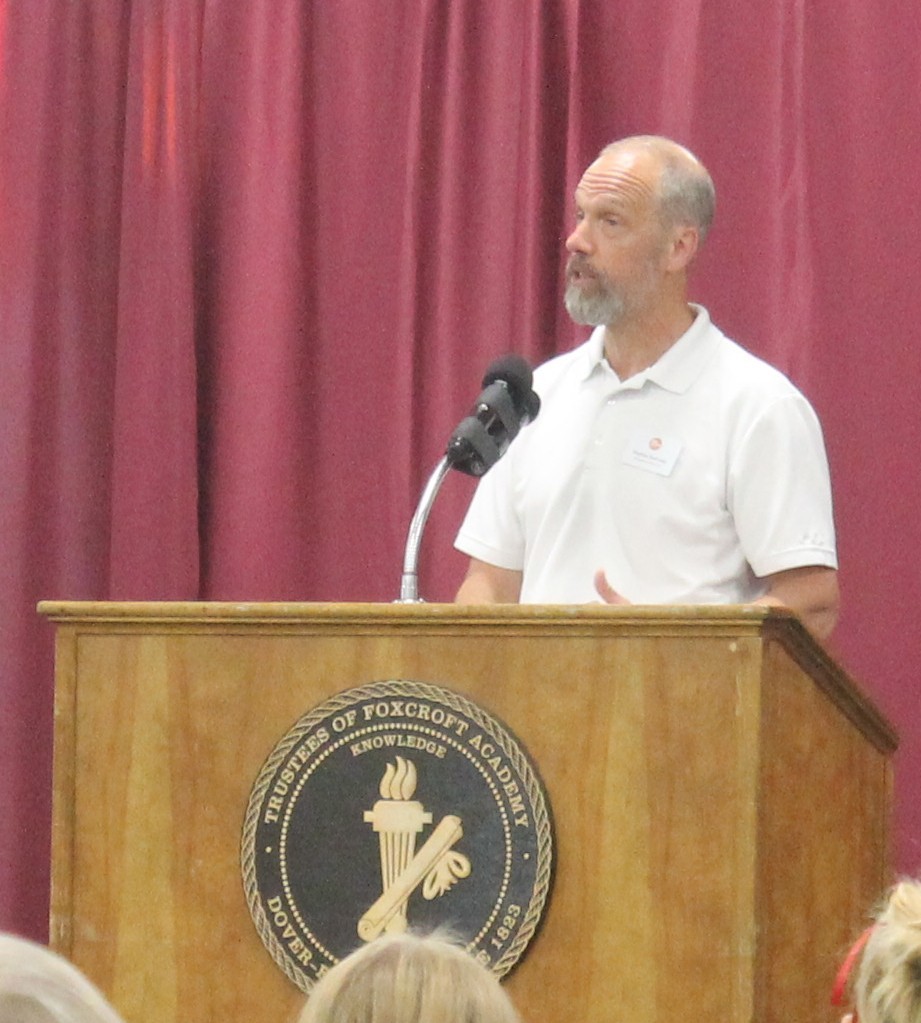
People would likely have learned about what happened in Philadelphia through a broadside, which Stitham compared to today’s email attachments or photography. Newspapers would print their own broadsides and this helped further spread the July 4 news to the remote corners of the new nation.
The final text of the Declaration of Independence was most likely penned by Thomas Jefferson, and this was rushed to the printer the evening of July 4.
“It is most likely that the original document, written in Jefferson’s own handwriting and actually signed by him, was damaged in the run of printing with running or smudged ink, ripped, torn or whatever and it was thrown away,” Stitham said.
“Copies were delivered by horseback in all directions,” he said. Later one went across the Atlantic Ocean to King George III.
The first public reading of the Declaration of Independence took place on July 8 at the Pennsylvania Statehouse. Gen. George Washington read a copy to troops and civilians on July 9 in New York City and members of the audience immediately went and demolished a statue of the king of England.
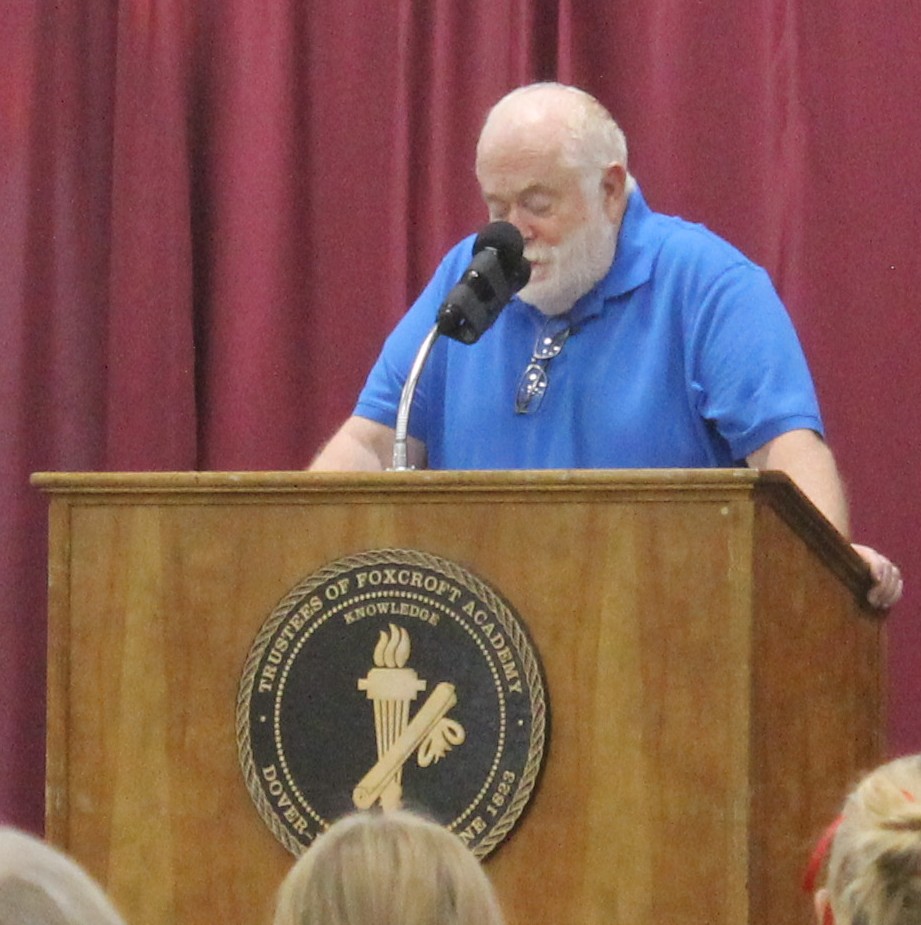
A Philadelphia newspaper was the first to print the text on July 5 and a Massachusetts newspaper did so on July 18.
Clergy across Massachusetts received broadsides.
“Ministers were instructed to read the broadside aloud to their congregations the first Sunday after receiving the document,” Stitham said. In this era churches functioned as primary community communication hubs and Maine had about 35 with most on the coast.
The Matlack version of the Declaration of Independence, named for Timothy Matlack, who was chosen in 1776 to inscribe the original United States Declaration of Independence on vellum or animal skin, became the third after Jefferson’s handwritten and the Dunlap Broadside. Fifty-six members of the Continental Congress from 13 colonies signed the parchment.
“It took courage to sign one’s name as each delegate knew that just by signing that each would be considered guilty by the king of capital crime of high treason against the crown,” Stitham said — a crime punishable by death.
He mentioned the final sentence of the Declaration of Independence, “And for the support of this Declaration, with a firm reliance on the protection of divine Providence, we mutually pledge to each other our Lives, our Fortunes and our sacred Honor.”
“Who are the people? Are there enough of these people actually willing to forever pledge their lives, fortunes and their sacred honor to the ever ending quest to secure for each and everyone their lives, their liberty and their pursuit of happiness?” Stitham asked. “250 years later, those two questions continue to remain.”
“Much as in 1776, the words of the Declaration deserve to be heard, shared and carried forward,” Shorey said.
He introduced four student leaders to read the document aloud to remind everyone of its ideals and the responsibilities of citizens.
Readers were Senior Class Vice President Jasmine Hall, Junior Class Vice President Kendall Killam, Senior Class President Jadenne Frigon and Junior Class President Alicen Kane.