Land trust plans for the future of Moosehead Lake Region
DOVER-FOXCROFT — For nearly two years the Moosehead Regional Land Trust has been working to conserve and protect the headwaters of the Kennebec and Penobscot River watersheds and sustain the tradition of public access to land in the Moosehead Lake Region and beyond.
The organization has developed a strategic plan for 2027-30 with a vision, mission, guiding principles and strategic core values. Plan details were presented at the Moosehead Regional Land Trust annual meeting at the Thompson Free Library pavilion on Saturday, Aug. 1, cohosted with the Piscataquis County Soil and Water Conservation District.
The annual meeting rotates around the region with the inaugural session being held in Greenville.
“We are more of a watershed organization than a land trust,” President and founding member Carla Ritchie said to attendees, a mix of year-round and seasonal residents of the Moosehead Lake Region. .”We feel that preserving and protecting the water and the watersheds and the water quality is just as important as the land and you can’t really separate the two of them.”
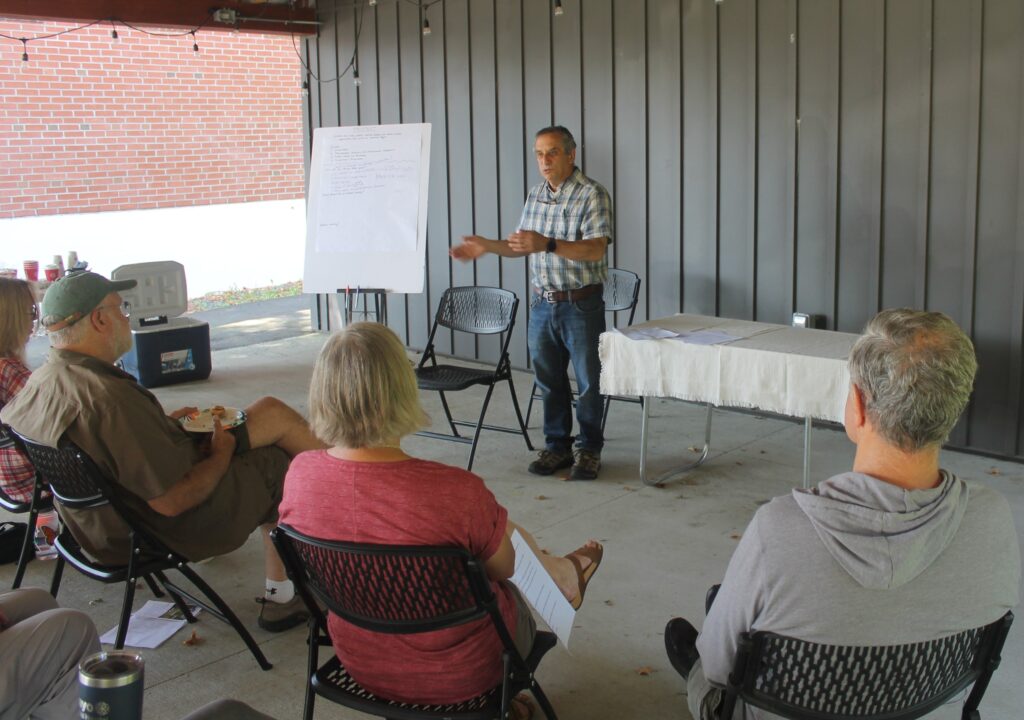
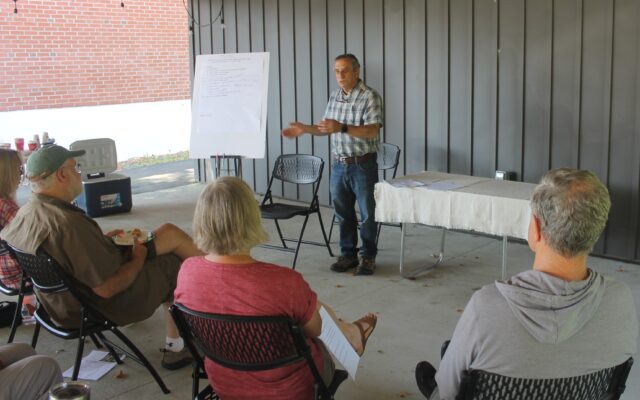
LAND CONSERVATION — Principal Jerry Bley of Creative Conservation, LLC in Readfield speaks on “How to Conserve Your Property” during the Moosehead Regional Land Trust annual meeting on Aug. 1 at the Thompson Free Library in Dover-Foxcroft. For over 30 years Bley has helped families and land trusts plan and conserve valued properties.
A land trust is a community-based nonprofit organization that works to care for and permanently conserve land, according to the Moosehead Regional Land Trust. Land trusts may acquire land directly or conserve land that remains the property of willing landowners (conservation easement). Habitat is protected for wildlife and plants; water quality is secured; and access to land for four-season recreation and other sustainable uses is ensured for future generations.
Beyond acquiring and managing conserved areas, many land trusts build strong partnerships with other local nonprofits and community organizations. Land trusts may offer environmental education programs in coordination with local schools and hold workshops on subjects of interest to local residents.
Land trusts can be local, statewide or regional. Those in Maine collaborate, share ideas, and promote best practices through the Maine Land Trust Network.
Property owners can donate land, sell it or place it under conservation easements. The land trust has a legal obligation to ensure all rules are followed on the easement in perpetuity, which can be loose or very specific, so there are negotiating points.
Much of the land would be open for recreation, while some parcels would be closed due to high ecological value. This could be for deer wintering areas or a bog with unique plants.
Ritchie, Vice President Bill Baker and board member Kay Johnson founded the organization. Johnson has been involved with the Friends of Wilson Pond since its formation 30 years ago.
Baker moved to the Moosehead Lake Region from Stonington where he had been involved with land trusts. He wondered where similar organizations were in Piscataquis County.
The Friends of Wilson Pond is the only land trust near Greenville — other large parcels are protected with other methods. That organization did not want to expand, so Ritchie (who serves on the Friends of Baxter State Park and Baxter State Park Advisory Committee), Baker and Johnston formed a new land trust.
Baker and Ritchie met while hiking on Big Moose Mountain and for him their first encounter was fortuitous with both wanting measures to place to preserve the natural resources.
“So here we are, some great board members and we are looking at a piece of land up in Blanchard — a nice small little piece right on the river,” he said.
Board member Jackie Robidioux, a wildlife photographer, rehabilitator and educator who is relocating to the region permanently after visiting for two decades, read the mission aloud.
The Moosehead Regional Land Trust conserves and protects the headwaters of the Kennebec and Penobscot watersheds while sustaining the tradition of public access to the lands and waters that define the Moosehead Lake Region.
“Watersheds are not just water, they are part of all the land around waters, the forests, the bogs, meadows, fields, ponds and streams,” Robidioux said. “By protecting these watersheds, you are protecting the wildlife.”
Many Mainers rely on wells for drinking water, making watershed protection critical.
“It’s all a connection, ourselves, the land, wildlife, the water,” Robidioux said. “All of us need to help and protect these areas.”
The Moosehead Regional Land Trust works to engage, protect and flourish, board member Sandy Scholar said. Over the next few years the organization will focus its work through these interconnected core values to strengthen conservation across the region while building an informed community and a resilient organization.
Engagement has been carried out through having a presence at and sponsoring events and conducting presentations and workshops. Protection is carried out through land conservation efforts and the organization is flourishing by achieving 501(c)3 status with the IRS, adding two new board members and developing its website.
The land trust has more than $111,000 in assets, including “a substantial anonymous gift” of over $102,000, Treasurer Pat Shafer said. The donation is in a high yield savings account.
“We’re solvent and our focus will be to drive up income through memberships and donations,” Schafer said.
All board members have agreed to stay on for another year, Ritchie said, with a formal vote putting the group in place.
They will work on carrying out the strategic plan vision of future generations who live in or visit Maine’s North Woods being able to experience a resilient and ecologically vibrant landscape where healthy forests, clean waters, thriving fish and wildlife populations and people exist in balance through thoughtful stewardship.
Five guiding principles shape every decision and action: community, integrity, sustainability, stewardship and science.
The Moosehead Regional Land trust would like community involvement, Ritiche said, with input on how to achieve its goals.