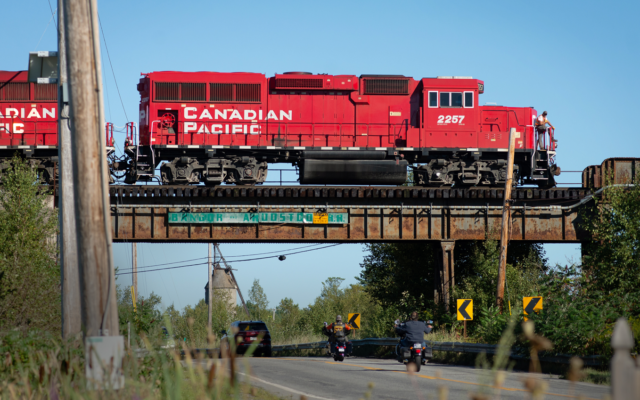
Rail companies investing millions in Maine as cross-border freight traffic grows
By Elizabeth Walztoni, Bangor Daily News Staff
Maine, which in many ways has been considered the end of the line in the United States, is now benefitting from its unique physical relationship with Canada.
The state sits in between Canadian cities such as Ottawa, Montreal and Quebec City to the west, and growing shipping container ports in New Brunswick and Nova Scotia to the east.
As a result, more products are being shipped in and through Maine by rail, and traffic looks set to continue growing as recently arrived railroads have expanded.
Major upgrades at Port Saint John in New Brunswick are bringing more container shipping to the region and two major railroads have recently started operating in Maine again. Those companies have invested millions in infrastructure and brought expanded, more reliable connections, though some critics have also questioned safety and whether more investment is needed.
Maine’s freight rail system connects markets and suppliers to the state’s major industries, including forestry, agriculture, manufacturing and energy. Improvements can bring more money into the state, make more fuel-efficient trips and lower costs for shipping through competition with trucking, theoretically bringing lower costs to consumers.
“Operators are seeing opportunity here in Maine, and they’re here to run trains and move product to make money,” said Nate Moulton, director of the state office of freight and business logistics.
Because railroads are private companies, public information about their activities is limited. But both major operators and the state confirmed that traffic has increased in recent years and signs show it’s on track to continue.
In its 2022 rail plan, MaineDOT projected the amount of freight moved in Maine by rail, and its value, would more than double by 2050 – from 4.5 million tons worth $4.4 billion in 2019 to 11.8 million tons worth $18.6 billion.
Most of the products moved here by rail have been associated with forest products coming from within the state, and petroleum and chemicals shipped from elsewhere.
Two major growth factors are upgrades to expand container shipping to Port Saint John and two of North America’s largest railroads re-entering Maine with money to invest in infrastructure and existing connections to larger networks.
Before 2020, no major freight railroad companies operated in northern New England, and hadn’t for more than 30 years.
Then, Canadian Pacific acquired the former Central Maine and Quebec railroad, which operated in Maine and Vermont. Its Maine track included a line between Jackman and Brownville Junction, where it intersects with another Canadian Pacific line connecting Searsport, Bangor and Millinocket.
That location also has a connection to Saint John in New Brunswick; from the Jackman side, it continues west into Quebec and meets the rest of Canadian Pacific’s system. The line added import and export opportunities in Searsport and Saint John, according to the company.
Canadian Pacific then merged with Kansas City Southern in 2023, creating the first single-line rail network connecting the U.S., Canada and Mexico. The company is now officially known as CPKC.
That was predicted to “dramatically” expand the market it served, to about 20,000 miles of rail, the company said at the time.
Two years later, CSX separately acquired Pan Am Railways, then Maine’s largest network with track from Mattawamkeag to Kittery. CSX’s holdings extend through the eastern U.S. and connect to Port Saint John through an operating agreement. The acquisition was expected to open significant new connections for Maine shippers and bring badly needed infrastructure upgrades, according to the state.
CSX hasn’t answered requests for specific information about how much it’s spent in Maine, but previously said it has put $100 million into former Pan Am lines, including tracks that extended to four other New England states. In 2022, more than 200 miles of the rail line’s network were subject to federal speed restrictions because of deferred maintenance or needed investments.
Last year, after upgrades were made, speed limits for some CSX tracks increased to 40 miles per hour from between 10 and 25 mph.
CPKC, meanwhile, has invested about $90 million in rail infrastructure upgrades since acquiring the Maine and Vermont lines, according to spokesperson Terry Cunha, and invests millions in ongoing maintenance in Maine each year.
Its larger Northeast network spans from Montreal to Albany, N.Y., with agreements extending to New York and Philadelphia.
Connections with shipping and logistics companies including Hapag-Lloyd and Americold are driving traffic and cargo activity in eastern Quebec, Maine and New Brunswick, according to Cunha, along with a cold storage facility that opened this month at Port Saint John. That’s expected to create a new temperature-controlled supply chain, the company said.
On an average day, two trains cross Maine on CPKC’s line connecting Jackman and Brownville Junction, Cunha said, one in each direction. Two more typically operate each day serving local industries.
Meanwhile, in New Brunswick, container shipping entering Port Saint John has grown 175% from 2021 to 2025 to handle almost 240,000 shipping containers annually.
The port finished $247 million in infrastructure upgrades last year, and is one of North America’s fastest-growing trade gateways, according to press releases. Tariffs and shifting trade have also helped it grow.
MaineDOT’s 2022 rail plan projects some Maine freight rail growth coming from more intermodal traffic as shipping containers entering that port by sea then move across Maine by rail to reach major cities in Canada and the Midwest.
About three-quarters of the state’s freight traffic originated in Maine in 2019, but through traffic was expected to nearly double by 2050 because of port improvements.
The plan also outlined investments that were needed in Maine’s network. Those included removing weight restrictions, adding train capacity and reopening dormant rail lines.
At least two currently dormant lines have gone out of service since CSX acquired Pan Am – one connecting Augusta and Waterville that served several major customers, and another between Bangor and Bucksport that has been mostly unused for years. The company previously attributed the closures to low demand.
Another company, TransloadX-RR, is seeking federal approval to lease and reopen those lines. Some labor unions and a competing railroad filed challenges to the proposal with federal officials and alleged that CSX was not upholding the investment and operating promises it made to acquire Pan Am. The lease proposal is still under federal review.
For Maine railroads to stay profitable and competitive, tracks and bridges also needed to be upgraded to regularly handle heavier freight cars with larger loads, which hadn’t happened at scale in 2022, according to the plan.
Millions in federal money have helped fund upgrades to Maine tracks through public-private partnerships in the last 15 years, such as $53 million awarded in 2024 to upgrade 140 miles of Eastern Maine Railway track with a connection to an industrial park under development at Millinocket’s former paper mill site, and $17 million in 2020 for upgrades between Waterville and Mattawamkeag.
MaineDOT also funds a partnership program for rail investments, which its latest three-year work plan funds with $13 million out of $70 million set aside for freight rail projects.
Track defects are the leading cause of derailments, not human error like was once the case, according to federal data.
Freight trains are also getting longer as railroads look for more efficiencies, making life frustrating for residents of towns they intersect – like Jackman, where residents can wait 30 minutes for trains more than two miles long, some of the longest in the country.
Rail shipping by weight and by value at the Jackman border crossing increased by nearly 70% between September 2024 and September 2025, according to state data.
Longer trains can also come with their own safety risks including derailments.
Between 2023 and 2025, 13 derailments were reported in Maine, federal data shows, the same total as in the three years before Canadian Pacific entered the state. A 2023 derailment of a CPKC train near Rockwood spilled hundreds of gallons of fuel.
Freight railroads generally police themselves and report their own accidents, and infrastructure shows signs of not being well-maintained, a 2024 Portland Press Herald investigation found.
Spokespeople from both major railroads said in brief responses to a request for comment that they prioritize safety and service.