Gordon Contracting awarded Lincoln Street bridge replacement contract
DOVER-FOXCROFT — The Dover-Foxcroft Select Board has approved a project bid for repairs and improvements of the Lincoln Street bridge by the intersection with North Street.
The bid comes several weeks after residents approved moving forward a bond not to exceed $2,500,000 for the project.
A $2,440,000 bid from Gordon Contracting of Sangerville was accepted by the Select Board during a Monday night meeting. This was the lower of two bids with the other being for $3,845,700 by New England Infrastructure Inc. of Hudson, Massachusetts.
Financing would be through the Maine Municipal Bond Bank. Over 20 years at a rate of 5.5%, the debt service would be just over $4.1 million with $1,628,000 in interest for the $2.5 million.
“It doesn’t look like we will have to borrow that much because the bids came in under, which is great,” Town Manager Alsina Brenenstuhl said.
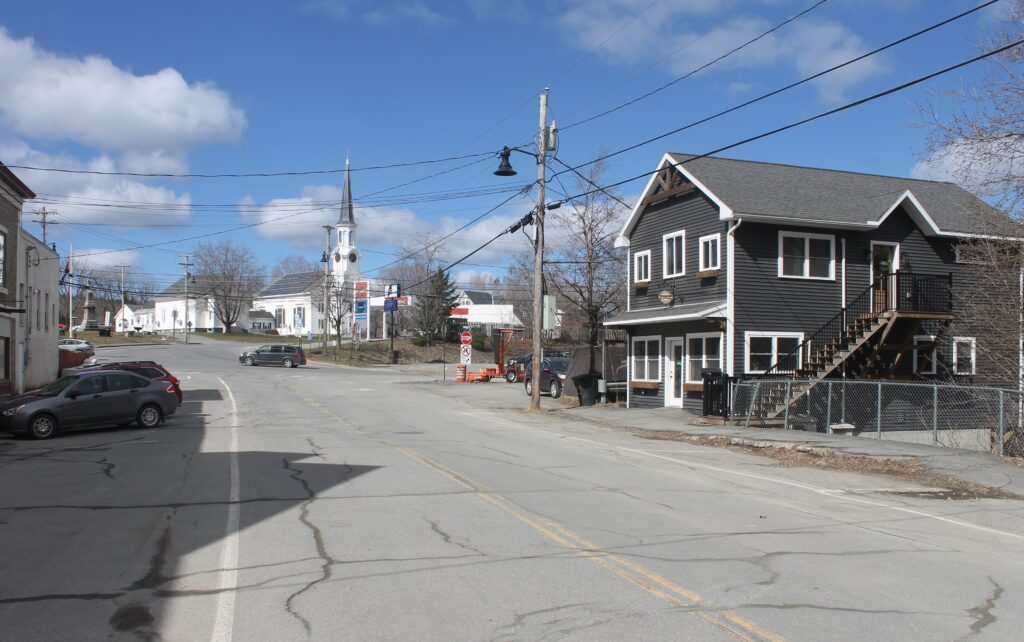
FUTURE CONSTRUCTION SITE — The bridge spanning the small stream underneath the end of Lincoln Street in Dover-Foxcroft. The replacement project has been awarded to Gordon Contracting of Sangerville.
Select Board Chair Steve Grammont wondered if the $1.4 million difference in bids stemmed from one contractor being local — Gordon Contracting President Brian Howard lives in Dover-Foxcroft — and the other being out of state. Brenenstuhl said this is a big reason why.
The town received about $1.4 million in congressionally directed spending in the 2024 fiscal year for the replacement project. The money needs to be used by September 2027 or else it will disappear, so the project needs to be underway before then.
This will not be a problem per the awarded bid.
“It’s an estimated two to three months, I am hoping they will knock it out earlier,” Brenenstuhl said.
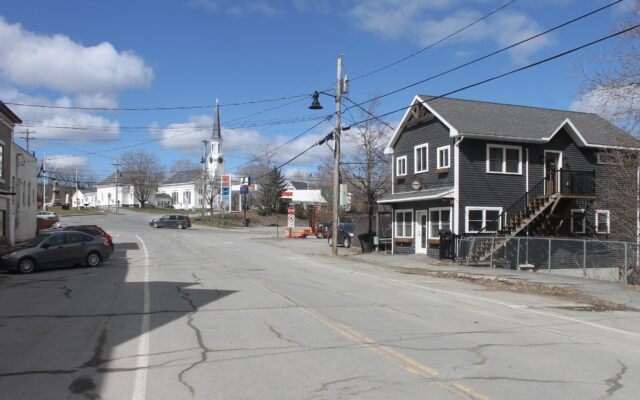
Many people don’t realize the end of Lincoln Street is actually a bridge with a culvert going underneath the span for a small brook emptying into the nearby Piscataquis River. The street is not in immediate danger of caving in, but this will happen eventually if steps are not taken.
Built in 1960, the bridge spans just under 17 feet and consists of a reinforced concrete slab on stone abutments. It features two-way travel lanes, angled parking on the south side, parallel parking on the north side and partial sidewalks on both sides of the street with businesses located on each side.
In June 2024 the select board approved a preliminary design for rehabilitation from Wright Pierce Engineers.
During a late 2022 inspection by the Maine Department of Transportation, the bridge was rated to be in poor condition.
The referendum earlier in the month passed via a 556-376 count.
In other business, the Select Board accepted a $25,000 grant from The Nature Conservancy to help develop a request for proposals to develop riverside amenities.
The Nature Conservancy and the Atlantic Salmon Federation are working with the town to remove the downtown Mayo Mill Dam and restore the town’s riverfront.
“There’s lots of conversation around what we will do with the land,” Brenenstuhl said.
Plans will be developed and could connect to nearby Monument Square.
After years of research, including work by two separate dam committees, last June residents voted 659-297 not to authorize the Select Board to borrow up to $9 million for the retention and repair of the dam. The Select Board was given the go-ahead to work with external partners to remove the Mayo Mill Dam on the Piscataquis River.
The dam surrender application is submitted to the Federal Energy Regulatory Commission and review takes about 18-24 months.
Permitting could be complete by 2027 and then the removal project can go to bid with an eye on the summer of 2028 for work. The schedule is subject to change.
Leaving the dam as is was not an option. The structure was obtained by the town after a mill closure in 2007 and it has not complied with federal regulations for more than a decade. The Federal Energy Regulatory Commission cited multiple structural deficiencies in a study. Ideas of retrofitting the dam and using it for hydroelectric power were deemed too expensive.
Had residents approved repairing the dam, the $9 million price tag would have been spread out across 25 years, with a 5% interest rate, putting the project cost at $14,107,600, including $5,107,600 in interest. The projected annual cost would have been $664,000.
About 9,000 people attended the 2026 Maine Whoopie Pie Festival at the Piscataquis Valley Fairgrounds on June 13.
“By all accounts it went very smoothly,” Grammont said. “We were all a little nervous with Essex Street closed.”
“It wasn’t an accident that things went well,” Gramont said.
Preparations between festival organizers and town departments ensured attendees got through town with one bridge leading to the fairgrounds being closed.
Organizer Patrick Myers will be meeting with the Select Board’s protection committee to go over a few tweaks to be put in place for the 2027 festival.
The June 9 election saw 1,139 votes cast in Dover-Foxcroft.
The total showed “strong community engagement and participation,” Brenenstuhl said.
She thanked election staff and volunteers and for their work.