Maine’s 2025 moose harvest report is out. Here are the key takeaways
By Susan Bard, Bangor Daily News Outdoors Editor
The Maine Department of Inland Fisheries and Wildlife recently released its 2025 moose harvest report, providing a comprehensive look at the state’s herd through detailed registration and age data.
Harvest totals and permit success
Maine’s 2025 moose season registered 2,309 total kills from 4,075 permits, for an overall success rate of 57%.
Permit allocations have remained relatively steady over the past five years, ranging from 3,969 in 2021 to 4,105 in 2023.
Standard Wildlife Management Districts (WMDs) accounted for 2,169 kills from 3,555 permits, a 61% success rate. The adaptive WMD 4A produced 140 kills from 520 permits, for a 27% success rate.
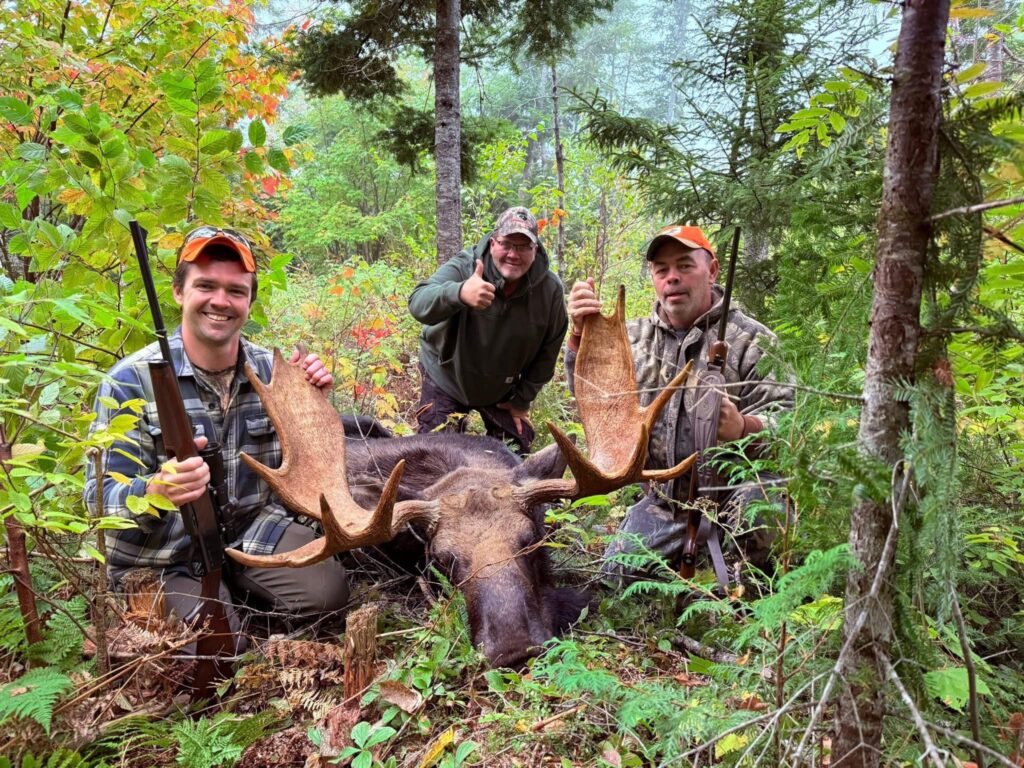
OPENING DAY BULL — Wyatt McCarthy shot this bull on opening day in Zone 11, accompanied by his father Kirby, acting as his subpermittee, and his cousin Russ Linscott.
The adaptive hunt was part of a multi-year management experiment aimed at reducing winter tick impacts by lowering moose densities in that region, particularly through increased antlerless permits.
Collectively, WMDs 1, 2, 5 and 6 accounted for about half of the statewide harvest and posted some of the strongest success rates. Several seasons within those districts exceeded 60%, with the highest reaching 78% in WMD 6.
WMD 4 (standard) and WMD 8 also delivered substantial harvests, with 269 and 223 kills respectively, and overall success rates of 54% and 64%.
Success varied by hunt timing and district. In many northern areas, September bull hunts lagged behind October seasons, while October antlerless hunts often produced the highest success rates within their districts.
September bull hunts posted lower success rates in every district compared to 2024, a decline state moose biologist Lee Kantar attributed in part to drought and warmer-than-normal conditions.
In WMD 1, the September bull hunt recorded a 51% success rate, compared to 75% during the October antlerless season. In WMD 6, the September bull season posted a 60% success rate, rising to 78% during the October antlerless hunt.
By contrast, the adaptive hunt in WMD 4A declined across three October hunts, dropping to as low as 21%.
Overall, nine districts posted year-over-year increases in success rates, while five declined and four were unchanged.
From 2021 to 2025, statewide hunter success averaged 60.8%. Success in the adaptive hunt dropped from 52% in 2021 to 27% in 2025, contributing significantly to the overall decline in statewide efficiency.
Age data and population structure
The 2025 report analyzed 1,999 teeth collected from harvested moose to determine their ages. The harvest was dominated by younger animals, with about 76% of moose between 0.5 and 4.5 years old. The most frequently recorded age was 2.5 years.
Calves were relatively rare, with 24 recorded among the sampled moose.
Approximately 19% of harvested moose were between 5.5 and 9.5 years old. Roughly 5% were 10.5 years or older. The oldest recorded moose was 16.5 years old.
A small subset of 13 moose reached 13.5 years or older, representing less than 1% of all sampled animals.
The median age of harvested moose was 3.5 years, with an average of 4.4 years.
What the data shows
The 2025 age distribution is heavily weighted toward younger age classes, anchored by the 2.5-year-old cohort, while still including a measurable number of mature and older animals.
Looking across the past five years, the median age of harvested moose was 3.5 years and the average age was 4.8 years, indicating no meaningful shift in the biological composition of the harvest. Over that same period, the number of teeth analyzed each year ranged from 1,950 to 2,181, with an average of 2,045 samples annually.
Taken together, the harvest and age data suggest that the decline in hunter success in 2025, down from 64% in 2024 and below the five-year average of 60.8%, was driven more by hunting conditions, particularly reduced performance in the adaptive management zone and lower September bull success, than by any measurable change in herd age structure.