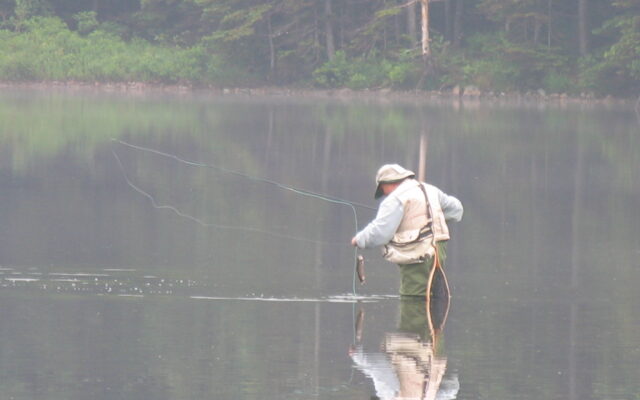
Why Maine’s fly-fishing-only and heritage waters matter for native fish
By Al Raychard
I have never been good at telling jokes and if I ever tried to make it as a comedian I would undoubtedly starve to death, but bear with me when I tell you this one. You may have heard it before, but it goes something like this.
There is a family of Maine fishermen suing the Maine Department of Inland Fisheries and Wildlife, claiming the fly-fishing-only rules governing some of our premier native and wild trout waters are unfair.
As I understand it, they want the regulations changed so anyone can fish any fly-fishing-only lake, river or stream in Maine and, here is the punch line — without restrictions.
Well, as Forrest Gump might say, “as stupid is as stupid does.”
The family is apparently backed by the International Order of Theodore Roosevelt, based in Marshfield, Wisconsin. Maybe I am out of touch, but I had never heard of the organization. Among other things, it supports efforts to pass a right to hunt and fish in all 50 states.
They must believe fly-fishing-only regulations impede someone’s right to fish, which they do not. The last time I checked, hunting and fishing are already legal in all 50 states.
Whether those activities should be constitutionally protected is a separate discussion. If they are not, I would likely support that effort. But changing Maine’s fly-fishing-only regulations so bait fishermen can harvest fish from some of our most sensitive trout waters is just plain foolish.
I have fished a number of Maine’s fly-fishing-only waters over the years. They are special places for many reasons, but I will focus on just two.
Maine is home to roughly 50 percent of the nation’s remaining native and wild brook trout and is the last stronghold of the species east of the Mississippi River.
As far back as the late 1970s and 1980s, I recall reading and hearing about how acid rain, warming temperatures, habitat loss and other environmental pressures were putting brook trout at risk.
In 2005, the Maine Department of Inland Fisheries and Wildlife and the Legislature decided to act. They created the State Heritage Fish Waters Initiative, a list of never-stocked brook trout lakes and ponds.
The initiative was expanded in 2007 to include a small number of Arctic charr waters and again in 2013 to include lakes and ponds that had not been stocked in 25 years or more.
The last time I checked, of the more than 1,200 lakes and ponds in Maine managed for brook trout, 585 are listed as heritage waters.
My numbers may be slightly off, but Piscataquis County appears to have the most heritage waters at about 250, followed by Somerset County with roughly 150.
Even so, less than half of the waters managed for brook trout fall under the heritage designation.
Some are regulated as fly-fishing-only waters and nearly all prohibit the use of live bait. Many still allow artificial lures and nearly all allow some level of harvest, though limits are often lower than under general fishing rules.
Again, my count may be off, but only about 200 waters in Maine are designated fly-fishing-only.
In addition, according to IF&W, more than 22,000 miles of rivers and streams in the state contain brook trout.
My first point is simple. If someone wants to fish live bait for brook trout, there are plenty of places in Maine where that is allowed, including some of the state’s most remote and wild waters.
My second point is this. One of IF&W’s primary responsibilities is to protect Maine’s fish and wildlife resources.
That is exactly what the department is doing with heritage trout waters while still allowing anglers to fish them.
The same is true for fly-fishing-only waters, which appear to be at the heart of this lawsuit.
Study after study has shown trout caught on flies and artificial lures generally have higher survival rates than fish caught on bait. Artificial lures are less likely to be swallowed deeply and cause less tissue damage.
When barbless hooks are used, as many fly fishermen now do, survival rates increase even more.
I have caught enough brook trout on flies to believe those studies are accurate. To be fair, I have not caught a brook trout on bait since I was a kid.
What truly makes no sense is the lawsuit’s assertion that anglers should have the right to harvest fish from Maine’s best trout waters under the state’s Right to Food amendment.
I have been fly fishing for more than 50 years and never once felt my rights as an angler were being infringed upon.
If you believe otherwise, you probably do not get out and wet a line often enough.
From what I have read and heard, the philosophy behind this lawsuit suggests fly fishing is an elitist activity dominated by wealthy people who discriminate against working-class anglers.
It also suggests that because working-class anglers buy licenses and pay taxes on fishing gear, they are unfairly barred from fly-fishing-only waters.
I do not know whether fly fishing is elitist or not. It is simply how I prefer to fish.
I consider myself working class and I am far from wealthy. Like most things that matter to me, I found a way to buy my gear and took the time to learn how to use it.
If this lawsuit succeeds and fly-fishing-only waters, including some heritage waters, are opened to bait fishing without strict limits, what comes next?
Allowing firearms during archery season because bowhunting is too hard? Spotlighting deer at night because daylight hunting takes too much effort?
Those ideas are ridiculous.
So, in my humble opinion, is this lawsuit.
I hope the courts find no merit in it, allow IF&W to do its job and let the case sink like a rock.