Maine lawsuit challenges fly-fishing-only waters under right-to-food amendment
By V. Paul Reynolds
Just when you think absurdity has surely reached its zenith, some well-intentioned but misguided group comes out of the woodwork to demonstrate it has no limits.
Maine plaintiffs Joe and Samantha Legendre, with the support of the International Order of Theodore Roosevelt, have filed a civil suit in Maine Superior Court against the Maine Department of Inland Fisheries and Wildlife.

They argue that IF&W’s designation of fly-fishing-only waters does not pass constitutional muster and that Maine’s relatively new right-to-food constitutional amendment renders those designations an unconstitutional regulatory act.
Of Maine’s more than 5,000 lakes and ponds, IF&W has designated 225 as fly-fishing-only waters. Some of these waters are catch and release and some are not.
The Legendres, readers may recall, are the same plaintiffs who previously sought to overturn Maine’s Sunday hunting ban.
In that case, they argued that the right-to-food amendment made the ban unconstitutional because it interfered with a citizen’s right to obtain food by foraging for wild game on Sundays.
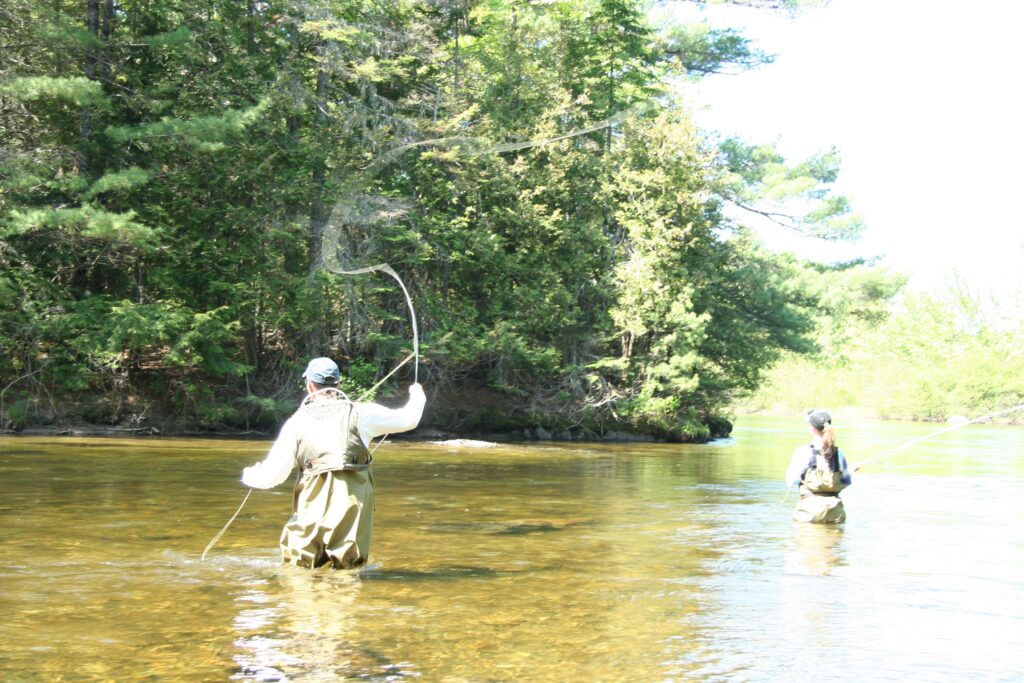
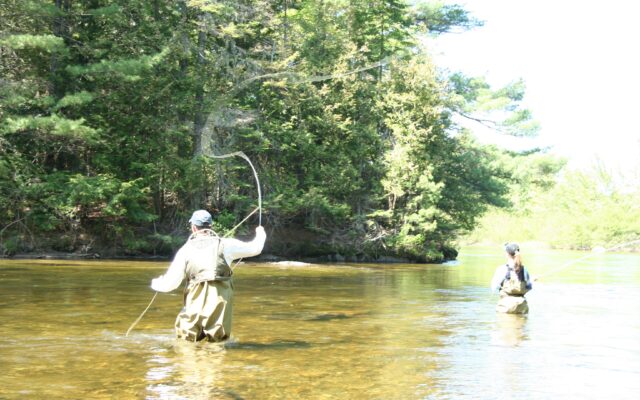
FLY CASTING — Scott, the author’s son, casts a fly on Grand Lake Stream — one of Maine’s fly-fishing-only waters — while his sister Lora fishes upstream.
That case was dismissed when the courts ruled that IF&W and the Legislature have the legal authority, through law and precedent, to protect Maine’s natural resources through regulation and management.
In the current case, Fish and Wildlife Commissioner Judy Camuso, named as the defendant, has filed a motion to dismiss. She argues the issue was already settled by the earlier ruling.
The Legendres counter that the motion should be denied because they cannot legally fish the Rapid River and other iconic trout waters with traditional spin-casting gear. They argue this restriction denies them access to food.
The whole kerfuffle seems silly and unlikely to gain any legal traction. Thank goodness. If it did, it could place Maine’s long-established system for protecting, preserving and managing its natural resources at risk, including its sport fishery and big game populations.
It is doubtful Maine voters intended the right-to-food amendment to create a free-for-all in the state’s woods and waters.
For me, the most offensive aspect of this lawsuit is the categorical stereotyping of the fly-fishing community. The suit language asserts this: “Fly fishing is a discipline dominated by the wealthy with high barriers to entry as compared to spin casting, in terms of both the cost of the necessary equipment and the time needed to master the technique.”
Are we to believe working-class people always spin cast and never fly fish? Playing the class card in this manner is straight out of the demagogic politician’s warped playbook. I don’t know about the Legendres, but Theodore Roosevelt is one of my heroes. The International Order of Theodore Roosevelt lists conservation as its mission. The abandonment of rules regulating Maine’s highly coveted trout fishery seems a perverse way to advance that goal.
The author is editor of the Northwoods Sporting Journal. He is also a Maine Guide and host of a weekly radio program “Maine Outdoors” heard Sundays at 7 p.m. on The Voice of Maine News-Talk Network. He has authored three books. Online purchase information is available at www.sportingjournal.com, Outdoor Books.