Maine’s frozen waterways come alive on skates
By Hazel Stark
Looking down past the white toes of my figure skates, I saw movement under the ice that wasn’t just the flowing vegetation. A deep, fast freeze early in the season had left the ice clear enough to see through and solid enough to skate on. I knelt on the ice, feeling the cold seep through my snowpants, and peered into the depths to figure out what had caused the movement. There it was: a turtle swimming through the reeds beneath the ice. I was about ten years old that day, and I will never forget that moment.
It’s not just the fun and speed of ice skating that makes it my favorite winter activity. It’s the scientific wonder and wildlife observations that skating on wild ponds, lakes, rivers and streams keeps me coming back for more.
Coincidentally, the day after I was asked to write this piece, my dad, Chris Stark, came across a letter he had written to his father in February 1995. I had received my first pair of ice skates the previous December. In the letter, he wrote that he had taken me to “an overcrowded ice skating rink in Bangor and promptly fell on top of her. Hazel responded by saying that she hated ice skating and never wanted to do it again.”
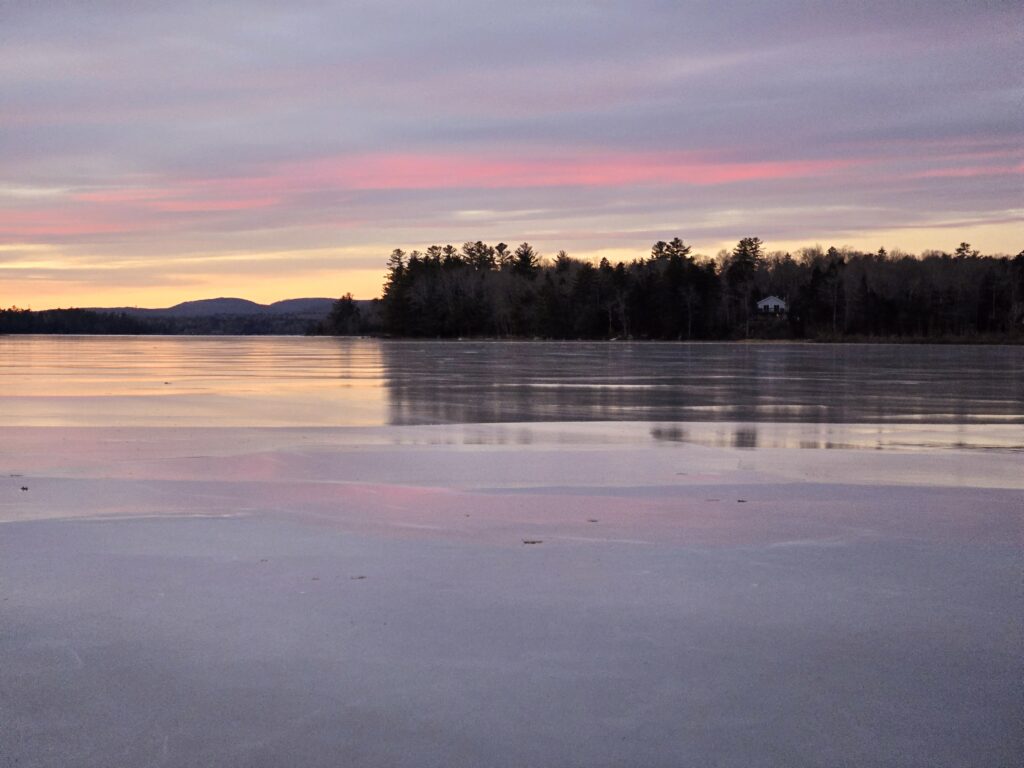
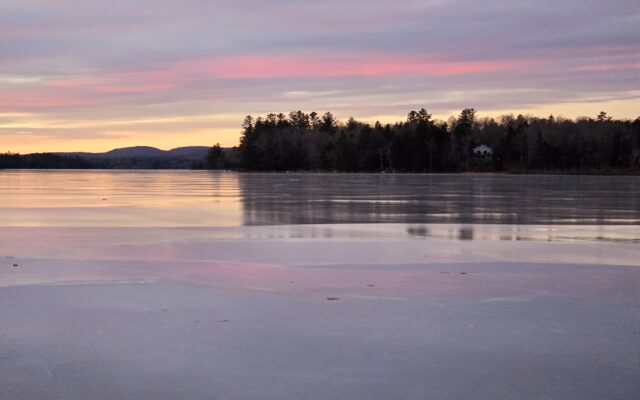
READY FOR SKATING — The frozen lake glows under a winter sunset, a serene moment for outdoor skating.
He went on to say that the following weekend I had done an about-face after watching a couple of my little friends skate outside and wanting to try it on my own, but “didn’t want any help. Within a matter of minutes, she was skating…on the second day she was practicing turns and balancing on one foot. Now she can’t wait until next weekend when she can do it again.”
It was about a month before my sixth birthday, but that childlike excitement for skating outdoors hasn’t left me.
To skate outdoors, you have to take safety seriously. I have never fallen through the ice and don’t plan to. The first step is to watch the weather closely once daytime highs stop creeping above freezing in late fall. My favorite conditions are nighttime lows below 15 and daytime highs no more than 25, with no precipitation or high winds. Just a few days of that cold can freeze shallow, still bodies of water. If temperatures dip into the single digits, it can happen remarkably fast.
Next, scout the nearest shallow, still body of water, like a small pond. If you see any open water, don’t skate. If it looks frozen, test the ice thickness. Many people skip this step, especially when they see tracks from other skaters.
I always bring a hatchet and chop a small hole all the way through, no matter how thick the ice. This lets me measure the thickness accurately, and the water that fills the hole will later re-freeze, preventing anyone from tripping. I repeat this process roughly every ten feet as I move toward what I think is the thinnest section, making sure it is safe.
Those fast, deep freezes are my favorite lead-up to ice skating because they create the most solid ice. On new, clear, turtle-viewing ice, you can skate safely when it’s just four inches thick, according to the Maine Lakes Ice Thickness Chart.
Watch for inlets and outlets, which may have currents, and check whether a body of water is spring-fed. Both of these conditions keep ice thinner for longer. Active beaver lodges are another important consideration. Beavers will break thin ice around their lodges to give themselves a way to escape to land with fresh food. Once temperatures stay in the teens consistently, though, they can no longer break the ice and remain sealed in their lodges under the ice until the next thaw.
Once we get some snowfall, good skating conditions deteriorate quickly. Snow makes it harder to see the quality of the ice, and a thick blanket can trap heat, creating slushy spots that are no fun to skate through.
But the first snow that blankets the ice doesn’t mean the skating season is over. Some deeper bodies of water take much longer to freeze and can remain open through that first deep freeze. I’ve seen one deep lake in particular take until late February or March to freeze thick enough for skating, creating a beautiful combination of snow on land and skateable ice on the lake.
Similarly, rivers take longer to freeze, and they are my favorite places to skate, though they require extra caution. Anyone who enjoys canoeing or kayaking can appreciate the appeal of traveling on rivers instead of lakes. On a wide body of water, the view doesn’t change much, but on a meandering river or small creek, the scenery is constantly shifting, making the experience far more engaging.
Rivers also serve as wildlife superhighways in the winter — why travel through dense forest when you can move more efficiently across a flat, frozen river? Prey animals often stick to the camouflage of the forest, but predators use rivers to cover ground in search of food. I almost always see bobcat, coyote or fox tracks on a frozen river dusted with snow.
These animals are much lighter than we are, however, so it’s important to test the ice regularly if you’re skating on a river with little current. Ice thickness can change dramatically from one bend to another and from the edge to the center. If the river freezes after a January thaw, for example, the water level beneath can drop, leaving the ice suspended unsteadily over air.
There are many types of ice skates, with hockey and figure skates being the most common, but really any will do in most circumstances, especially if you get them sharpened annually. I have always used figure skates, which can be tricky on especially bumpy ice since the pick on the front can get caught, but they give me plenty of directional control and I feel very comfortable on them.
Just this year, I started using Nordic skates. They are sold as longer blades that clip onto a cross-country ski boot, leaving a free heel and a floppier-feeling foot compared with the stiff boot of figure or hockey skates. They also allow for longer travel over ice of varying textures and perform especially well on bumpy surfaces. When you want to go on land, you simply remove the blade instead of changing shoes.
All the eccentricities of ice formation are part of the allure. Outdoor skating conditions are so variable and weather-dependent that they force us to pay attention, and when we do, we always learn or discover something new. I have skated a stretch of river where I found the remains of a deer frozen in the ice, surrounded by frustrated coyote tracks unable to reach the meat below. Around the next bend, a birch tree was full of redpolls, little Arctic finches that often come to Maine for the winter. On a pond, I’ve seen the characteristic belly slide of an otter next to the trudging trail of a porcupine that had moved through the slushy surface before it froze solid.
I’ve studied maps to figure out how to link a series of ponds and lakes, with some bushwhacking, to create a ten-mile loop of mostly skating, usually after work, through sunset and under a full moon. Ice skating keeps me observant, aware and most importantly, filled with the same childlike glee about the wonders of nature that has no age limit.