Residents move Maxfield one step closer to dissolving
By Kasy Turman, Bangor Daily News Staff
MAXFIELD — Residents of a Penobscot County town are one step closer to dissolving their community.
Maxfield residents voted 19-7 in support of continuing the deorganizing process on Monday.
The vote was the second of 12 steps to deorganize — the process in which a municipality ceases to be an independent town and becomes part of Maine’s Unorganized Territory. The process can take between one and a half and two years to complete.
Maxfield is one of two communities to vote on whether to deorganize this year. Highland Plantation, a community of around 50 people in Somerset County, is voting on Saturday. Maxfield resident Valerie Harper brought forward a petition to begin the process. She cited a lack of businesses, young residents and engagement in the town’s Select Board as reasons to look into disbanding. Fifty of the town’s 89 residents signed it.
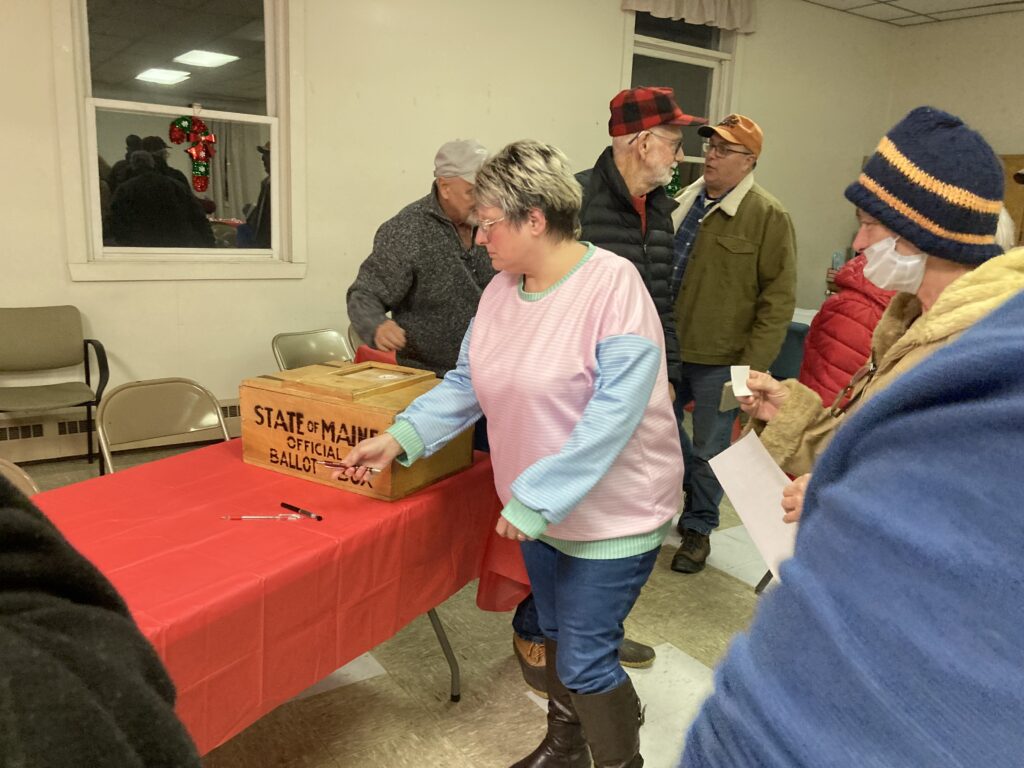
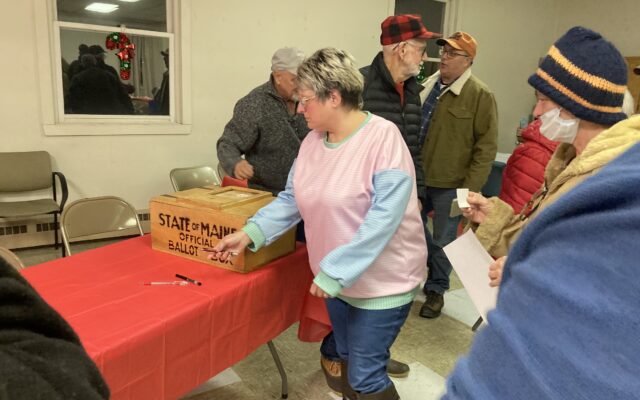
DEORGANIZE — Maxfield residents cast ballots to deorganize on Monday.
Residents asked multiple questions to a panel of seven state and county officials about the process during the meeting. Many of the questions were about how long it would take to deorganize, how much it would cost and not having representation.
There was no clear answer if dissolving would lower taxes for residents.
“That’s a very hard question, and I don’t think you’d get anyone up here to give you a definitive answer, because, again, when your plan gets put together, there are tangibles in there that do affect that issue, like your roads,” Harold Jones, state fiscal administrator for the Unorganized Territory, said.
The unorganized territory has a $6.52 tax rate. Maxfield’s rate is roughly $23 per $1,000 in property value, or $2,300 for a property valued at $100,000.
Maxfield would need a revaluation to predict what taxes would look like, Jones said, because the town hasn’t had one done since 2006.
Multiple residents said taxes would most likely not go up even with a revaluation.
A five-person committee was formed at the meeting. Residents Valerie Harper, Michele Woodard and Amber Boobar were nominated by attendees and voted in.
They will create a deorganization plan to outline how the town’s services will be provided by the county. The plan will be submitted to a deorganizing commission in 90 days.
The plan will then go to the Penobscot County Commissioners, the state legislature and two more resident votes.
If residents were to vote down the process at any point, the town could not bring disbanding back up for a vote for another three years.
Although a plan is not yet in place, Penobscot County Unorganized Territory Director, George Buswell said the town would most likely continue to be in the Howland fire district. Residents would create a cemetery committee to oversee maintenance.
The roads, which Buswell said were not up to the standard that the Penobscot County Commissioners expect roads to be kept, would not be able to be fixed in the first year.
“I’m not going to pretend that we could fix the roads in year one, because I don’t see how budget wise that could even happen,” he said.
Creating a two to three-year plan to fix the roads would make the most sense. A plan is not yet created and would require approval from the commissioners.
The longest part of the dissolving process is “divorcing” from MSAD 31, the school district for Howland, Enfield, Edinburg, Passadumkeag and Maxfield, said Rick Colpitts, director of education for the Unorganized Territories. Leaving the town could be done by July 1, 2027 at the earliest, on what Colpitts called a “tight timeline.”
If the town were to deviate from that timeline and stay with the district for another budget, the date would be pushed back to 2028.
After joining the Unorganized Territory, Maxfield residents would pay $140,000 for schooling, Colpitts said. Residents currently pay about $133,000 for schooling for 12 students, Select Board Member Marjorie Sage said.
Other processes, including joining the Maine Land Use Planning Commission, selling or donating town properties and settling debts, would be quicker than leaving the school administrative district.
Selling local buildings would go toward the cost of dissolving, which officials said could cost more than the current taxes.
Citizens questioned if there were stipulations put on 353 acres of school lots preventing its sale when the property was initially given to the town. The deeds cannot be found in the county or town’s registry of deeds.
The deeds may have been destroyed when the house of the town employee who was keeping them burnt down, Sage said.
Despite not having clear answers on if taxes would be lowered and how expensive the process will be, the town should at least start the process, Boobar said.
“I think we need to be realistic in that this process, if we go forward, will be expensive, but I think it’s probably worth it,” she said.