Practical tips for photographing snowflakes this winter
By Aislinn Sarnacki
When I was a little girl, I learned that no two snowflakes are alike. Each has a unique pattern — complex, symmetrical and beautiful.
However, that was around the time that I learned that if you swallow a wad of gum, it’ll stay in your stomach for exactly seven years. This well-circulated “factoid” is false, an old wives’ tale to deter kids from ingesting things they shouldn’t.
So, naturally, I’m suspicious about snowflakes. Could each one truly be unique?
Well, sort of.
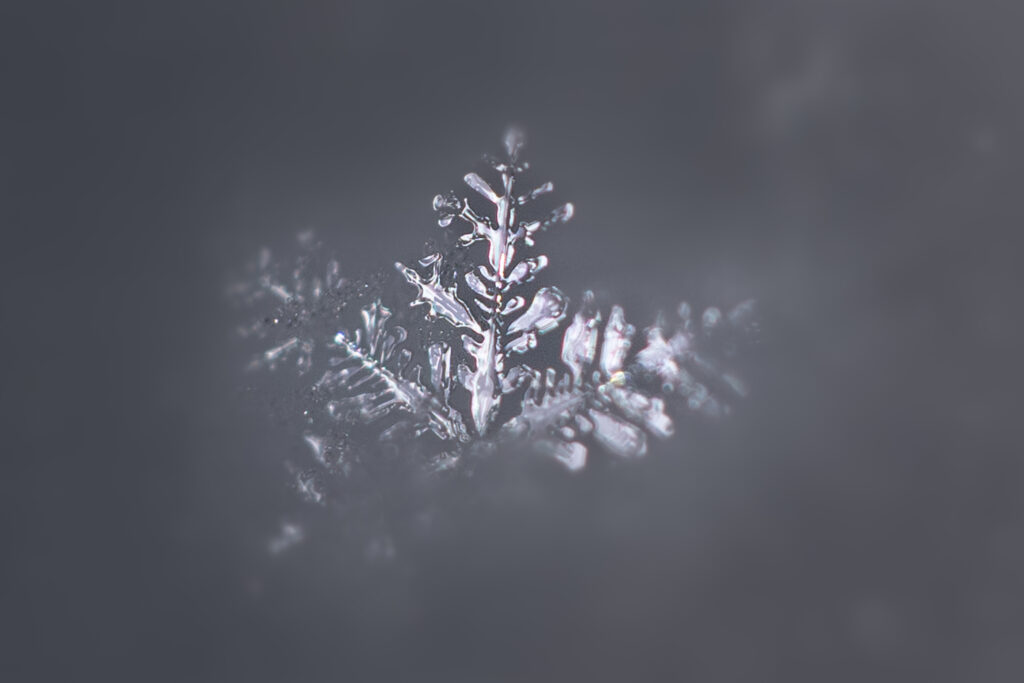
REFLECTION — A snowflake reflects light on its flat surface, causing it to shine brighter than the snow it sits on if seen from a certain angle.
According to the Smithsonian Science Education Center, there’s credence to the hypothesis. While snowflake shapes can be sorted into about 40 categories, scientists estimate that the design possibilities are so numerous that it’d be “almost impossible” to find two identical specimens.
Snowflakes are essentially miniature ice sculptures formed by nature. As they tumble through the sky, traveling from clouds to the ground, their crystalline structures form, building and branching into intricate patterns, which are influenced by the different temperatures they encounter along the way.
You can view these delicate sculptures with the naked eye, if you look close enough. Or you can use a magnifying glass. Or — as I have been attempting to do lately — you can photograph them.
About a year ago, I purchased a 100-mm macro lens for my camera so I could photograph small things in more detail. Mushrooms, wildflowers, insects, lichen — they’ve all been subjects of my recent macrophotography experiments. But snowflakes have been the most challenging subject yet.
Here in Maine, the beginning of this December has been exceptionally cold, with temperatures dipping well below zero, thanks to a disruption in the polar vortex. And it’s during cold snaps like this that we often see some of the most elaborate snowflakes fall from the sky.
So, after a snow shower earlier this week, I attempted to photograph snowflakes, and my method was simple: I knelt in the snow and shifted back and forth, waiting for sunlight to flash off the surface of an intact snowflake. I’d then try to find that snowflake with my camera — which I often failed to do — and adjust my settings and focus before pressing the shutter button.
Most photos came out blurry or dark. I had to be at just the right angle to catch sunlight bouncing off the surface of the ice crystals. But I did capture a few neat images.
The next day, I altered my method slightly. Instead of relying on sunlight to illuminate snowflakes, I carried a headlamp. Moving the light over the surface of the snow, I could much easier pinpoint specific snowflakes to photograph.
It had snowed the night before, and I noticed that the fresh snow didn’t contain any complex snowflake shapes. However, if I scraped away the top layer of snow, I found a variety of fancy snowflakes underneath. They’d simply been buried.
When it comes to macrophotography, I have a lot to learn. Many professionals use special flashes and reflectors to light the tiniest details in their subjects. They also use editing software to stack multiple photos on top of each other for a crisper final image.
Meanwhile, I just wave a headlamp over a snowbank and hope for the best. But that’s OK. I enjoy the process. I’m not ready for all those bells and whistles.
My recent attempts to photograph snowflakes reminded me of the fictional novel “About Grace” by Anthony Doerr, in which the main character is a hydrologist who struggles to photograph snowflakes while living off the grid in Alaska. The character is inspired after seeing the images produced by the real-life snowflake photographer Wilson Bentley (1865-1931).
A meteorologist and photographer from Vermont, Bentley is known as the first person to photograph a snowflake up close. Starting in 1885, he photographed more than 5,000 snowflakes over the course of 47 winters.
His method was simple but effective. He would catch a snowflake on black velvet, then photograph it with a camera attached to a microscope, before it melted. To do this, conditions had to be just right.
You can see more than 2,000 of his photographs in the book “Snow Crystals,” originally published in 1931 and revived in years since. In addition, many of his snowflake photos are preserved in the Smithsonian Institution Archives and on display in an exhibit run by the Jericho Historical Society in Vermont.
By the way, Bentley never found two snowflakes that were alike.
“I have yet found no exact duplicate,” he wrote. “In this inexhaustible storehouse of crystal treasures, what a delight is in store for all future lovers of snowflakes.”