SeDoMoCha students showcase science fair projects
DOVER-FOXCROFT — How much polyurethane should be on a basketball court in order to ensure the surface has enough grip for players’ sneakers as they run back and forth, but not too much grip which could cause an ankle injury?
SeDoMoCha Middle School eighth grader Sariah Martin wanted to look into this for her project in the annual grade 8 science fair held on the evening of April 29. Seventy-two students in science teacher Jonathan Dumont’s classes had worked on their projects since December with the final displays set up in the cafeteria and gymnasium.
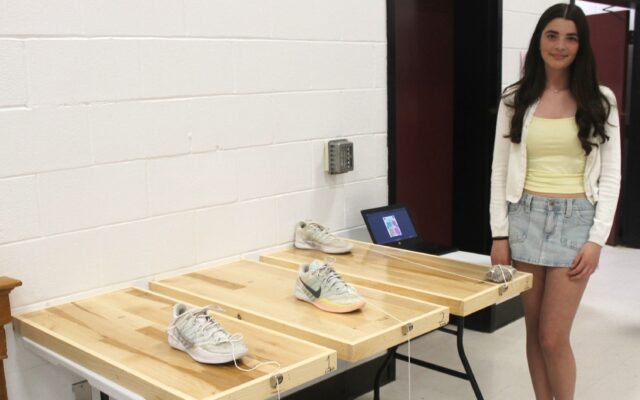
Martin constructed three replica basketball court surfaces on a table for the science fair. Each had a different number of polyurethane coats, one, three and six. To test the three, she had a sneaker attached to a string with a rock tied to the other end. Dropping the rock moved the sneaker along so Martin could study the impact of the surface coating.
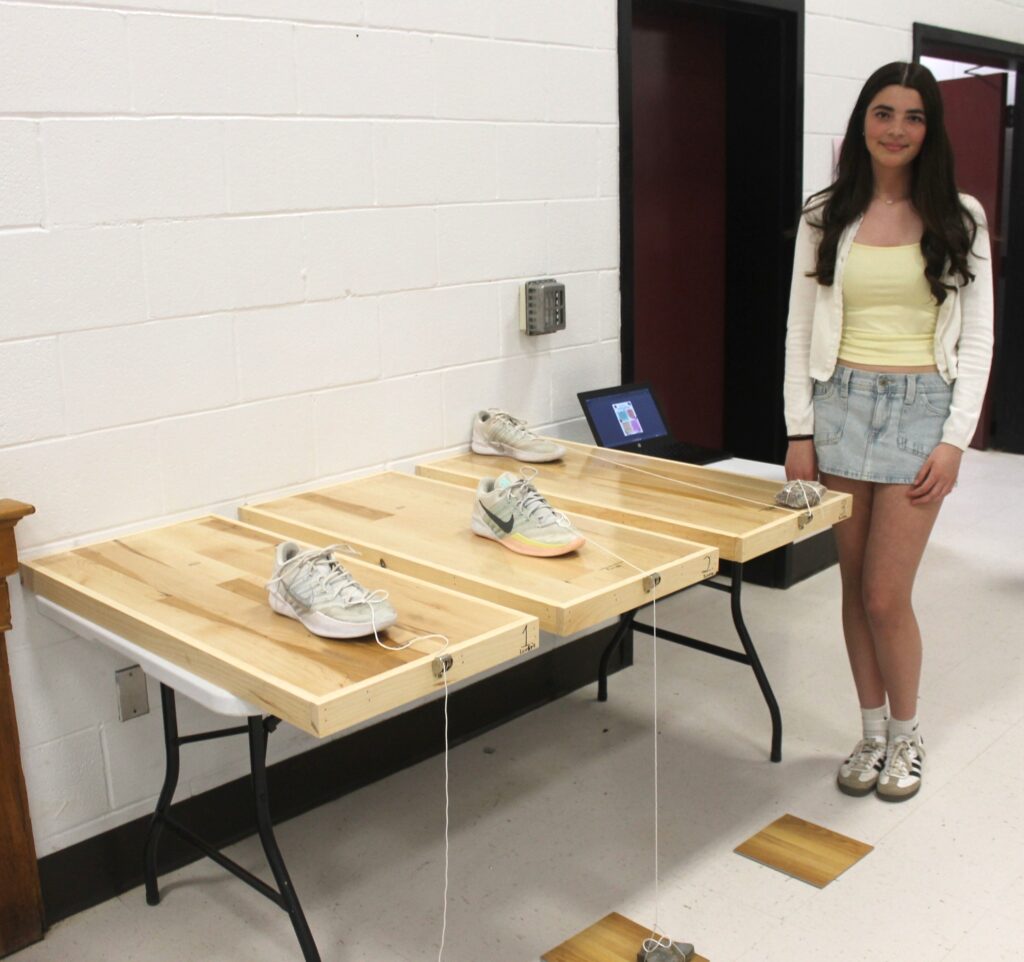
SNEAKER GRIP — SeDoMoCha Middle School eighth grader Sariah Martin examined three different amounts of polyurethane layers on replica basketball courts for her project in the annual science fair. Attendees of the April 29 event at the Dover-Foxcroft school could see that three coats was the best between one, three and six layers as demonstrated by the sneakers moved along the wood via a rock tied to the other end of the string.
She discovered three coats was the best of the three options.
“There was enough grip but not too much grip,” Martin, who plays basketball for the SeDoMoCha Eagles, said. She had thought three layers would be the best in her hypothesis and this turned out to be correct.
Other student based their projects on sports they play.
Nick Hall looked into soccer ball weights to see what pound may be more accurate.
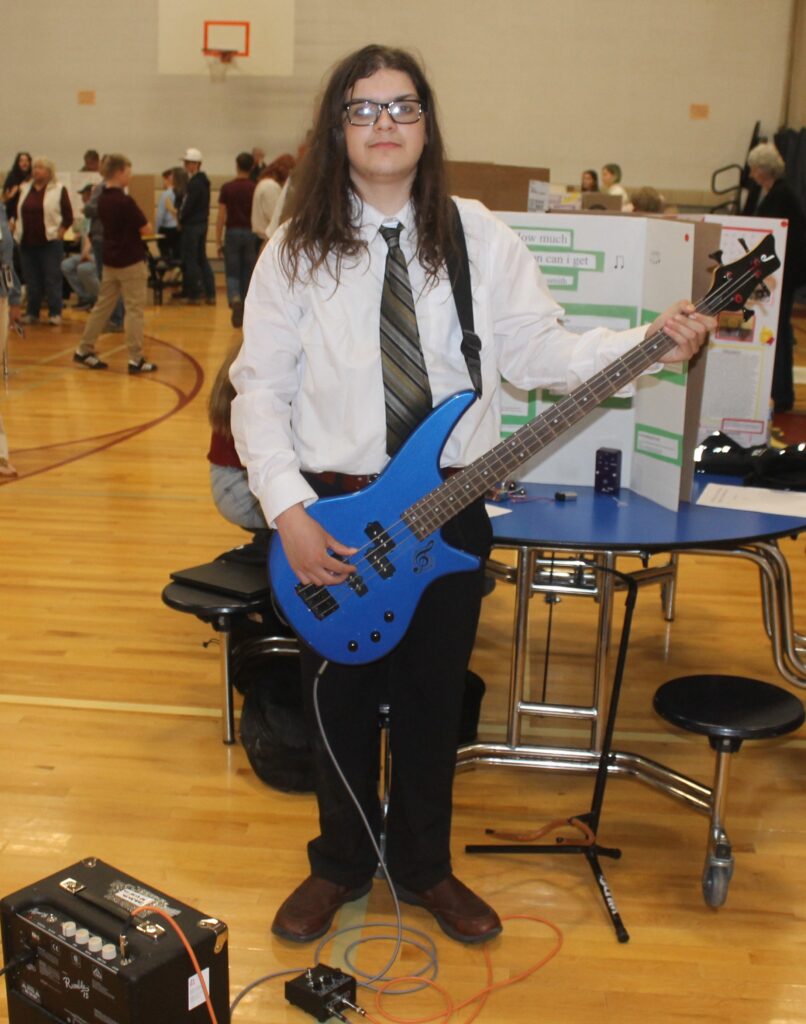
BASS DISTORTION — Gabriel Smith looked into distortion for his science fair project. A musician, Smith had his bass and amp set up for demonstrations.
Hall had three friends kick at a goal set up at the Jim Robinson Field House with pieces of tape spaced 6 inches apart on the netting. The aim was to get their shots on goal using three different weighted balls as close to the middle as possible with Hall recording everything in slow motion. He then used Google Sheets to record all the data.
A heavier soccer ball led to greater accuracy, Hall found.
As a base on the SeDoMoCha cheer squad, Ava Pulkkinen is quite familiar with stunts involving a flyer being tossed into the air and then caught by teammates. This helped give her an idea to test how high and far different weights traveled.
Pulkkinen attached a weighted vest to the handles of a pogo stick with different rounds of testing featuring 11, 16 and 20 pounds.
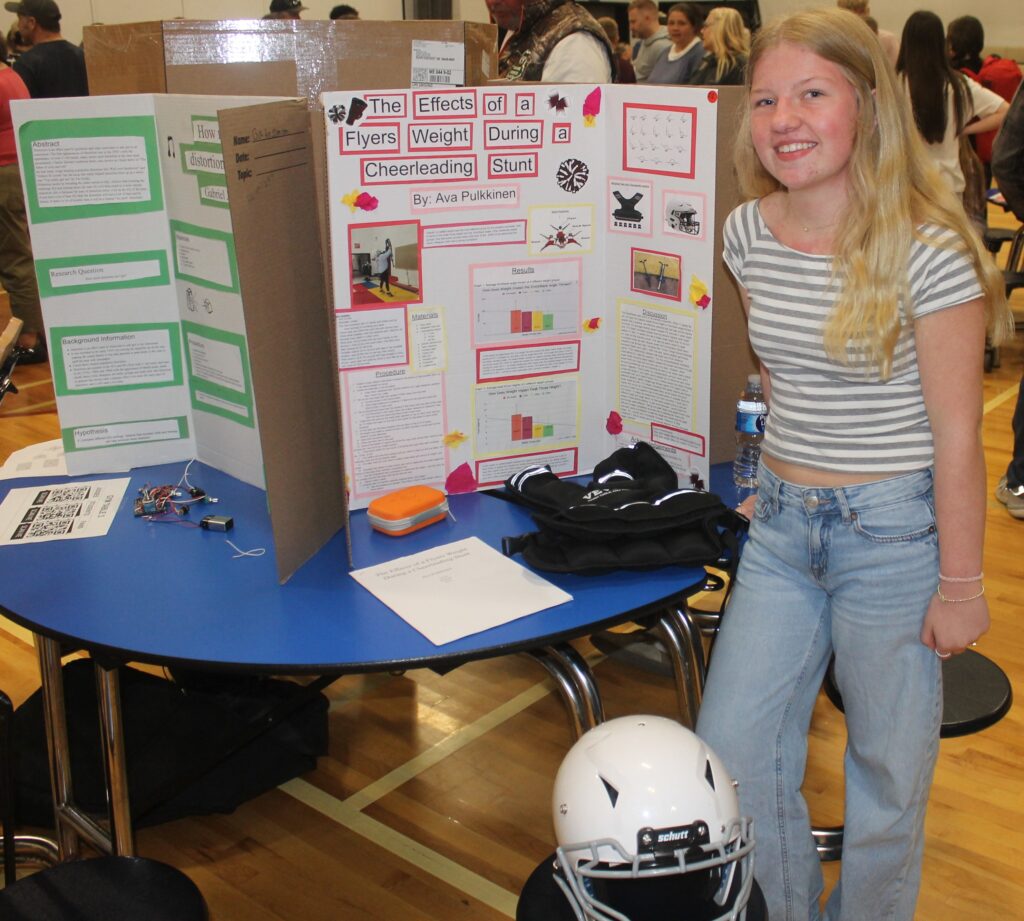
FLYER WEIGHT — A member of the SeDoMoCha cheer squad, Ava Pulkkinen looked at the effect of the weight of a flyer during a stunt. She attached a weighted vest containing different amounts of ponds to a pogo stick to examine distance.
“The heavier it was the further back it went,” she said, with the pogo stick and vest placed next to her poster board. Pulkkinen also had a football helmet, worn for safety during testing.
Evan Omoigiade enjoys working out and decided to look into rest time, muscle fatigue and maximum muscular effort.
His test subjects did a plank for 45 seconds, had 30, 60 or 120 seconds of rest and then planked for another 45 seconds. Electrodes recorded data for Omoigiade to analyze.
Thirty seconds of rest led to the best ensuing performance, he found. This could be due to less buildup of lactic acid or simply the test subject had less time to think about the ensuing exercise.
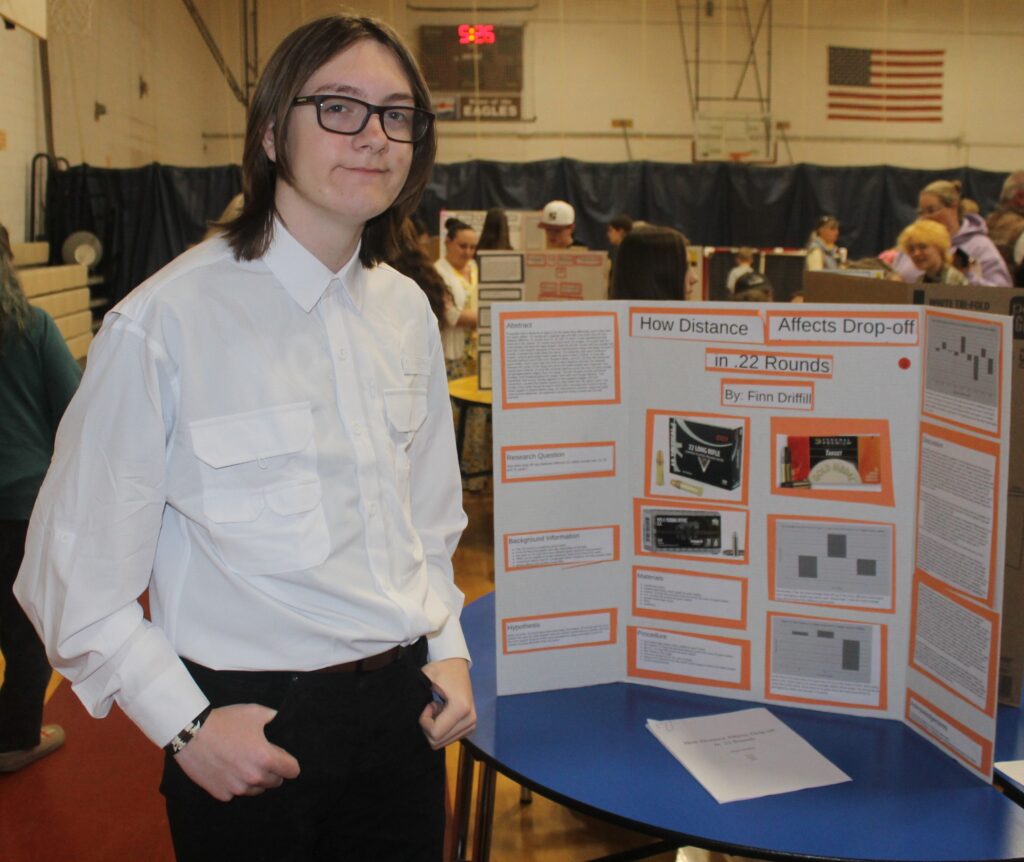
DISTANCE AND DROPOFF — Eighth grader Finn Driffill shows his science fair project examining how distance affects drop off in .22 rounds.
“All rest times were better than no rest times,” Omoigiade said about back to back planks.
“I wanted to do something I normally wouldn’t do and I really don’t garden,” Bailey Ames said.
With “Too Sour to Sprout,” Ames tested how seeds grow in different levels of soil acidity.
“I learned the lower the pH, the less seeds sprout,” she said, saying she may garden some day.
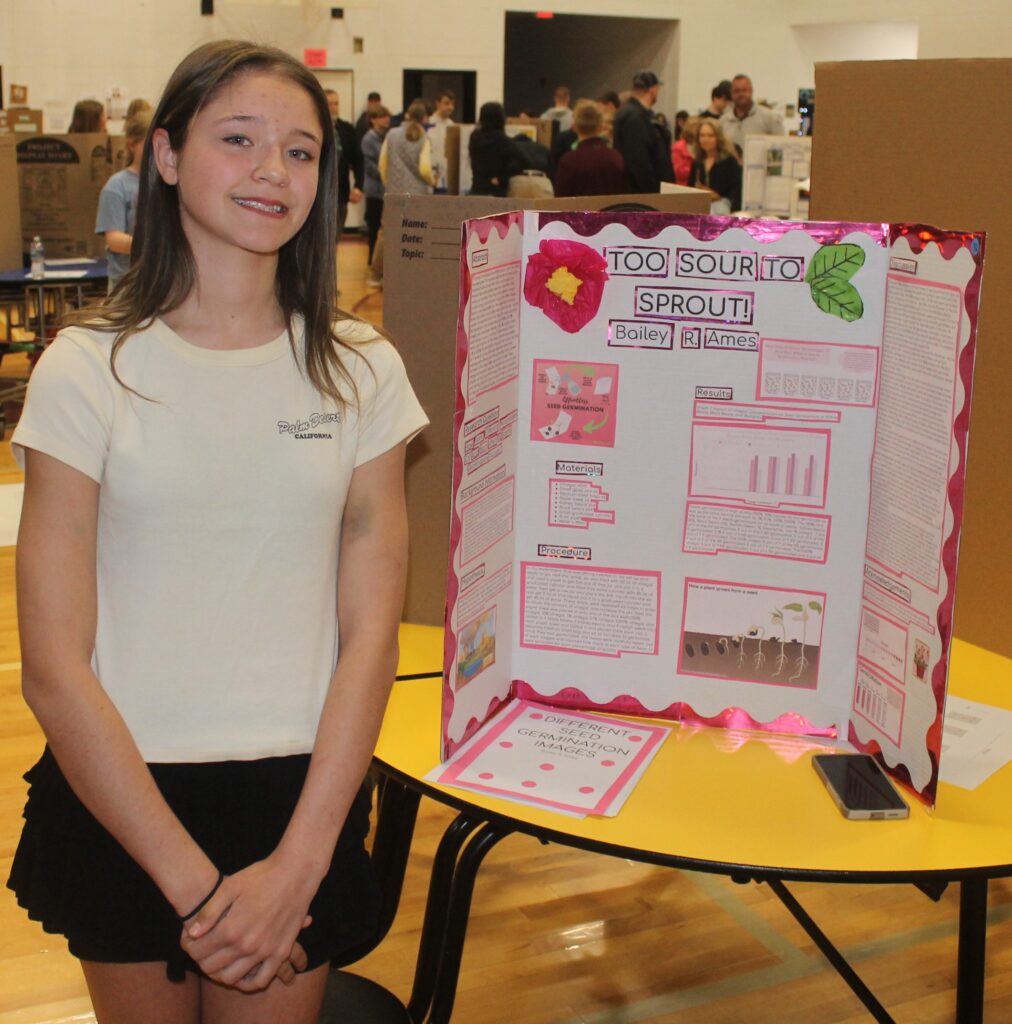
HOW DID HER GARDEN GROW? — Bailey Ames found the lower the pH level the soil is, the fewer seeds sprout.
Genevieve LeProvost wanted to have her science fair project involve the medical field. She looked at the impact of blood pressure on blood vessels. A bucket with holes drilled into the plastic allowed the placement of tubes to replicate the vessels.
A panel of judges, made up of community members and Foxcroft Academy students, looked at the projects and five awards were handed out.
Visual Presentation: Kennedy McKenney; Background Information: Audrey Cleaves; Experimental Design: Brayden Hodges; Data Analysis: Lilah French: and Overall: Kaydiense Nelson.
The five and 14 other projects, deemed by the judges to have a good design and analysis, will move to the Maine Middle School Science & Engineering Fair Wednesday, May 20 at Bangor High School. This will be the first time in a number of years SeDoMoCha will be taking part, Dumont said.
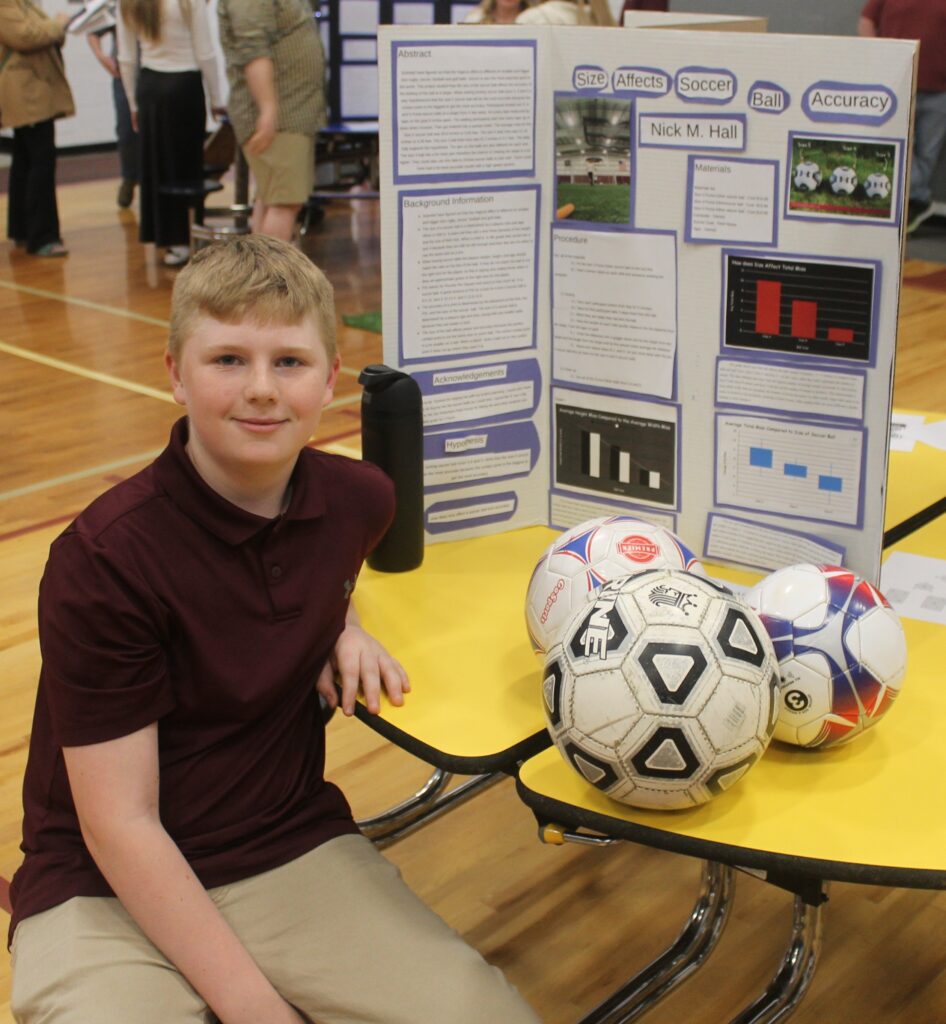
GETTING A KICK OUT OF IT — Nick Hall recorded shots taken on a soccer goal in slow motion to examine how close these came to the center of the net to help analyse the best of three ball weights.
Students began working on their ideas before the turn of the year, he said. In late February and early March many eighth graders tested their projects and from there they got everything ready for the science fair.
New for this year, some students conducted large-scale data analysis. Examples include statistics from a mold company and oil change numbers from a garage.
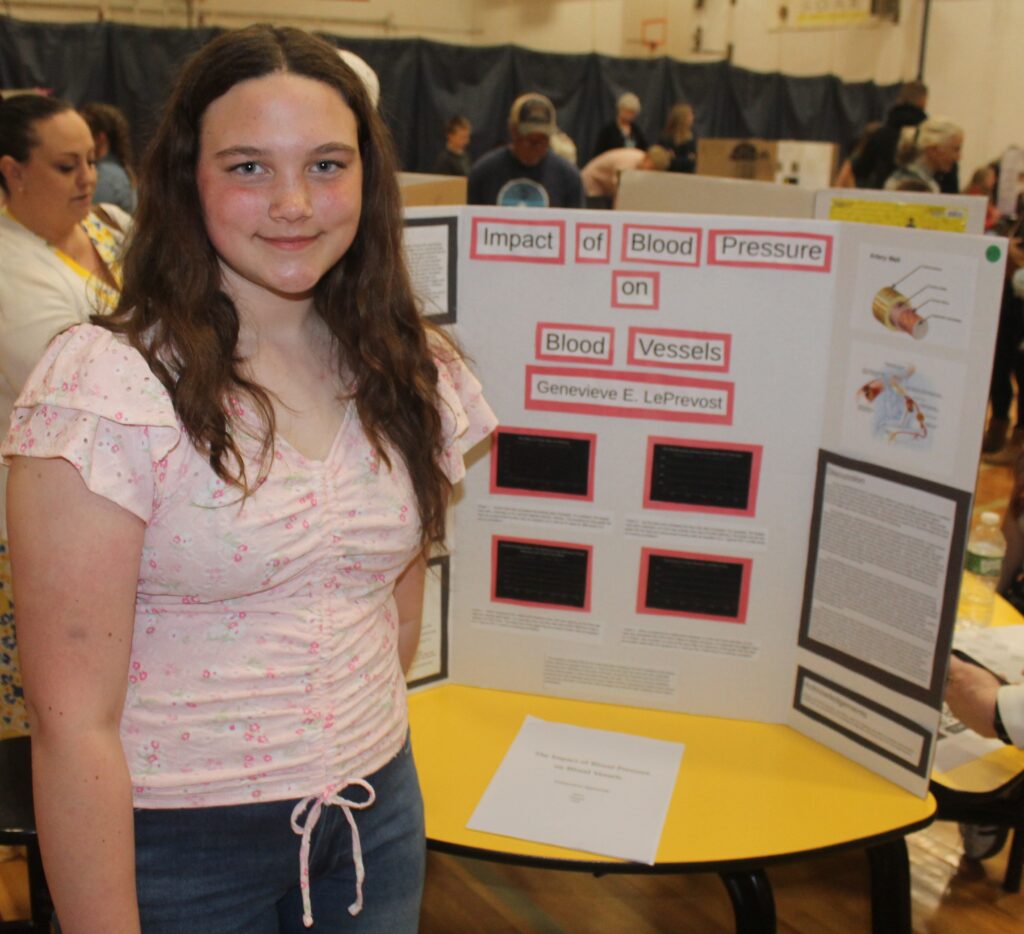
MEDICAL EXPERIMENT — The impact of blood pressure on blood vessels was the subject of Genevieve LeProvost’s science fair experiment.
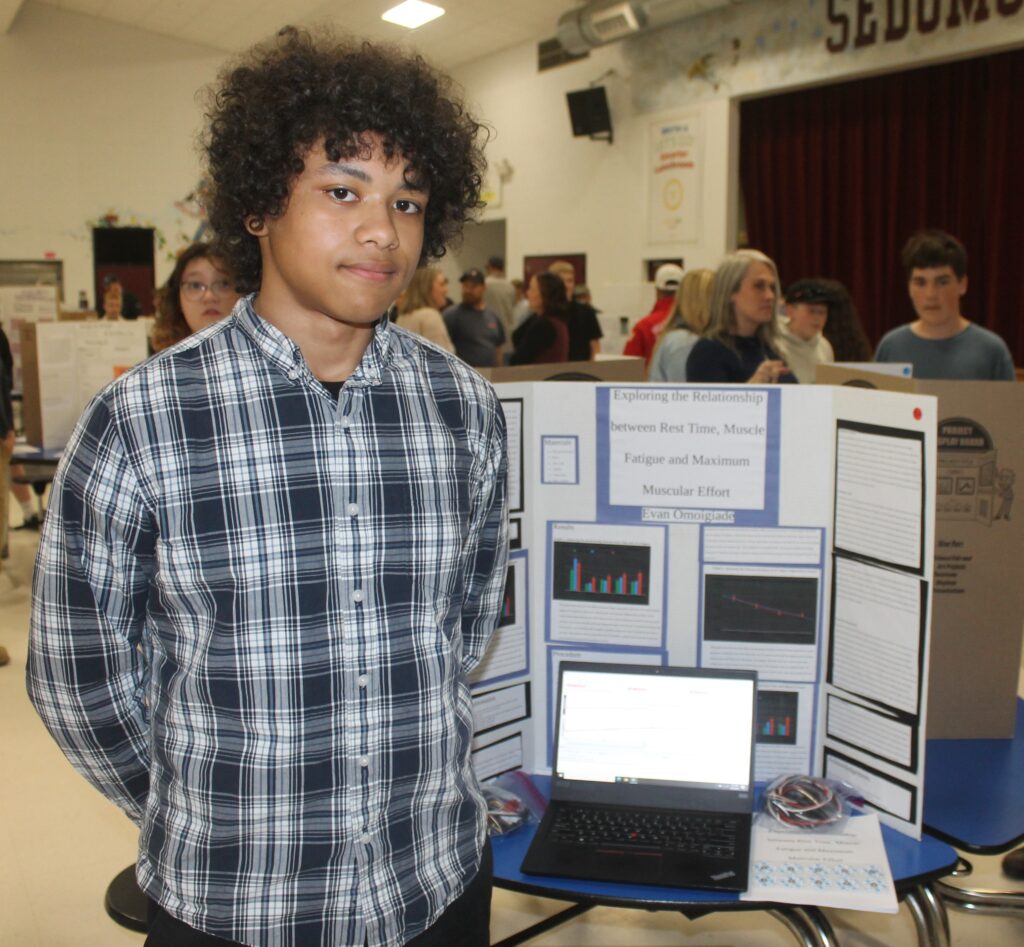
BETTER THAN NO REST AT ALL — A shorter duration of rest in-between is ideal for exercise performance, Evan Omoigiade found. He also saw that a longer stint is better than no break at all.