
When do pellet guns make sense for hunting and pest control?
By Al Raychard
Pellet guns, also known as air guns, have grown in popularity in recent years. I’ve owned a few for a while now, and while I’m still learning the finer points of pellet shooting and hunting, I can attest they’re fun to use, handy to have and sometimes more practical than traditional firearms.
The question is: are pellet guns suitable for hunting?
Legally, it’s a mixed picture. The Bureau of Alcohol, Tobacco, Firearms and Explosives generally does not classify pellet guns as firearms under federal law.
In Maine, they’re not considered firearms under the criminal code, so no background check is required. When it comes to hunting, however, regulations are less clear. I couldn’t find any specific mention of pellet or air guns under either the general hunting laws or the sections on hunting equipment.
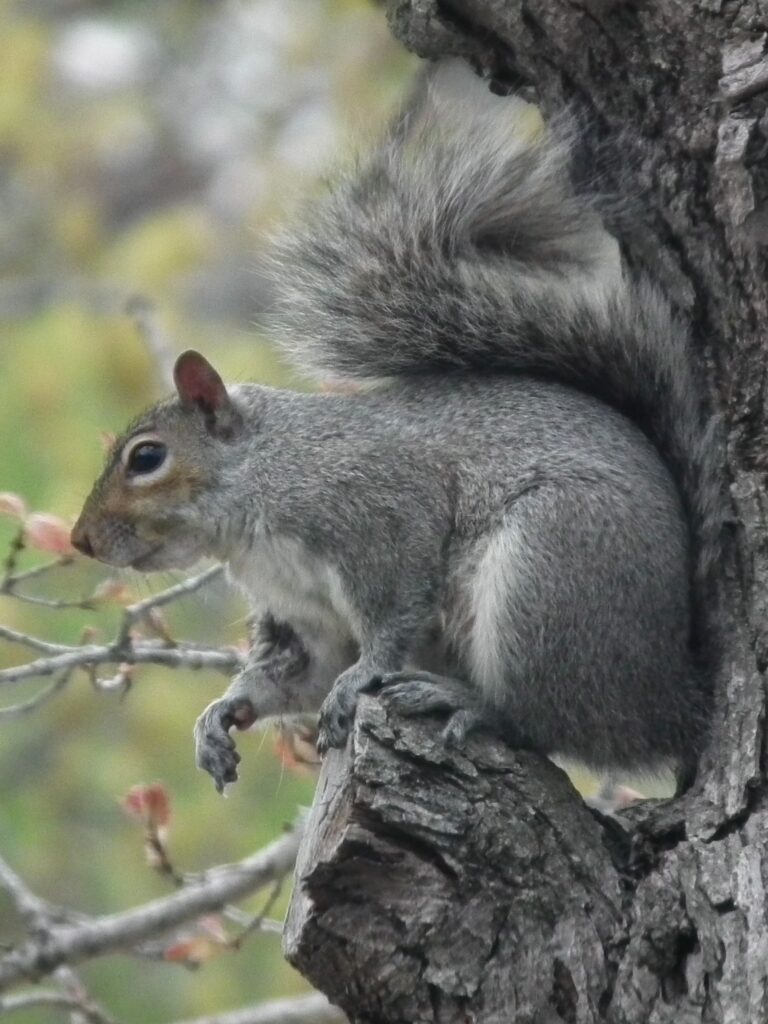
SQUIRREL — A tree-top squirrel, a familiar sight around gardens and feeders.
The only relevant language I found states that “firearms with .17 or .22 caliber rimfire cartridges may not be used for deer, moose or bear hunting, except that .22 magnum can be used for deer hunting.” That restriction is repeated under hunting equipment for deer and bear.
Spring and fall turkey may only be hunted with shotguns or archery equipment. Since pellet guns aren’t mentioned, the implication is that air guns are legal for hunting small game. Still, hunters would be wise to confirm current regulations before heading afield.
When I purchased my first pellet gun, it wasn’t for traditional hunting but for pest control around the house, our vegetable and flower gardens, and especially around our bird feeders in late fall and winter. Every time we filled the feeders, two or three squirrels showed up each morning and cleaned them out. Being too close to the house for a high-powered firearm, a pellet gun seemed ideal.
I needed a caliber large enough and powerful enough to humanely kill at least squirrel-size targets. My first gun was a .177 caliber. I chose it because it was the most popular pellet gun caliber at the time. Pellets were widely available and affordable, and from what I read, what the store clerk told me and what I heard from other owners, the .177 had sufficient power. In time, after putting the rifle to work, I learned that it did and it didn’t.
The .177 is the smallest pellet gun caliber, typically offering the fastest velocity and flattest trajectory. It also drops less over distance than larger calibers. That’s great for plinking and small pests, but I found it wasn’t always effective on larger ones. It would certainly sting squirrels and let them know they weren’t welcome, but it didn’t always have the killing power I wanted.
The issue wasn’t just caliber size, it was the rifle and pellet I was using. Not all rifles of the same caliber deliver the same power. I had a spring-piston rifle, generally considered low to medium power, and I was shooting relatively lightweight pellets under 8 grains.
Looking back, had I done more research or spoken with more experienced shooters, I would have started with heavier 9- to 10-grain .177 pellets. When I eventually made that switch, I lost some velocity but gained energy, and the results on larger pests were noticeably different.
By then, my interest had expanded beyond household pest control to hunting squirrels and dealing with the occasional woodchuck or raccoon that can invade and damage a garden just as Swiss chard, Brussels sprouts and other vegetables are ready to harvest. I don’t expect to hunt snowshoe hares with a pellet gun, but if I ever do, I want to be certain I’m using a rifle powerful enough to ensure a humane kill.
That led me to my newest pellet rifle, a .22 caliber powered by a gas piston, specifically a nitro-piston design. Gas-piston rifles are similar to spring-piston guns but rely on a sealed piston driven by compressed gas. The result is a higher and more consistent power level with less vibration. .22 caliber pellets come in a wide range of weights, from about 10 grains up to more than 30 grains.
According to the manufacturer, my break-open gas-piston rifle shoots a 14- to 15-grain .22 pellet at roughly 900 feet per second. While the velocity is slower than my .177, the energy delivered is significantly higher and has proven more than sufficient to dispatch squirrels.
I haven’t yet needed to take a woodchuck, hare or raccoon in our gardens. Whether I would depends entirely on the situation, legality and the ability to make a clean, humane shot. I believe a .22 caliber pellet rifle could do the job, but shots would need to be close, likely under 30 yards, with precise shot placement to the head.
Before attempting that, I’d want to experiment with heavier 16- to 18-grain pellets, which are about the upper limit recommended for my rifle. I’d also want to test different pellet designs. I’ve been shooting pointed and hollow-point pellets, which offer penetration and expansion respectively, but there are other designs worth exploring.
Finding out what works and where the limits are is part of the fun.