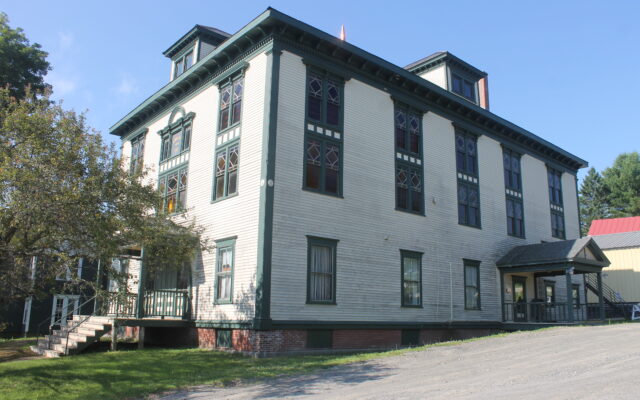
Work continues on Sangerville Town Hall grant possibilities
SANGERVILLE — The town hall committee and Sangerville Historical Society have been meeting regularly to explore funding opportunities for rehabilitating the building.
The town hall, built in 1901 and listed on the National Register of Historic Places, has been vacant for several years due to safety hazards. Fundraising efforts are underway to restore the structure. In the interim, the town office has moved across the street into rented space, paying $1,700 a month at 93 Main St.
One possibility is up to $500,000 in the form of a Maine Historic Community Building Grant. Earlier this year Sangerville had its application for a $250,000 grant for the town hall turned down. A round two application can be sent by mid-October and the community could receive even more funding in this next round.
Town Manager Brian Mullis said during a Sept. 2 Select Board meeting at the fire station that the Maine Historic Preservation Commission has been responsive to his inquiries on the application.
Many residents are not on social media, so the groups have discussed sending out a mailing on the project. The historical society could potentially cover the postage costs and volunteer labor to prepare the letters to avoid the use of any tax dollars.
Last month, the Sangerville Historical Society pledged to sell its museum property at 9 Douty Hill Road to cover the 25% match required by the Maine Historic Community Building Grant.
Three real estate agents have assessed the museum property at approximately $100,000. Pledges and other fundraisers would help net $125,000 to meet the full match requirement.
The hope is the historical society would be able to have a new home for its collection and operations in the renovated town hall, which in turn would lead to greater visibility in the building space that formerly housed the library.
Should the grant application fall through, then the town will continue to work on other grants and money people have pledged will still go toward the town hall.
A sum of $400,000 was raised at the 2024 annual town meeting, which is now in a capital reserve account. Roof repairs have used about $42,000, which puts the account at nearly $360,000.
This amount plus a $500,000 grant and $125,000 from the historical society would equal close to $1 million.
Renovation costs depend on scope. The foundation should be secured first to restore occupancy, though upper floor work could be deferred if that section is closed.
The foundation work was estimated around $440,000, but the amount has likely risen in recent years. Another $10,000 to $20,000 is needed to fix wiring and lighting to pass insurance inspections.
At next March’s annual town meeting, officials plan to let residents know what has been done and present upcoming plans for a vote.
Stabilizing the stained glass windows could cost up to $40,000. They cannot be tipped because the leaded glass could buckle or crack.
“The fear is once you get in there and jack that building up and do the foundation work that we could be cracking this essentially priceless stained glass,” Mullis said. He is looking into a potential $25,000 grant to protect the windows.
Some town hall window glass has been shot out by BB guns, Town Clerk Michelle Nichols said. She is unsure how this can be protected but takes pictures every time she goes into the building.
“We need to do something so we don’t keep losing glass out of the windows,” Nichols said.
Selectperson Jamie Kane, a lieutenant with the Piscataquis County Sheriff’s Office, said the culprit is likely a juvenile and it can be tough to prosecute this age group.
In other business, a cannabis ordinance ad hoc committee met the evening before and looked at a 32-page commercial-grade business license application.
The code enforcement officer should be involved in the application process and this additional time would likely increase the budget for the position, Nichols said.
The committee will meet next on Sept. 22. Once it is finished the application will go to the planning board.
In late June, 72 residents voted unanimously to pause new commercial cannabis licences for 180 days. The measure was brought forward to address municipal officials’ public health and safety concerns over larger scale marijuana businesses in town.
A seven-member ad hoc committee then began working with the planning board to develop a town ordinance to serve the community beyond the 180 days. After review by legal counsel and approval by the Select Board, the document will go before the voters at a special town meeting.
If this timeframe is not long enough to develop and pass an ordinance then the Select Board can extend the ban for another 180 days.
Mullis checked in with Dexter Town Manager Trampas King to learn about the neighboring community’s tax club. Dexter began the program in 2014 and now has about 150 property owners enrolled to pay their property taxes monthly over a year.
Select Chair Jeff Peters said a decision on the adoption of a tax club in Sangerville should be up to residents.
“I think a well-researched warrant article for town meeting is the best way to handle this,” he said.
Nearly 950 tax bills have been paid so far — approximately 80% — with about 280 remaining, Nichols said.
Mullis also discussed Dexter’s recent comprehensive plan updates as the town contracted with Eastern Maine Development Corp.
“Now that had a pretty hefty price tag, $24,000,” he said.
Having a smaller population, such work may not be as costly for Sangerville. The town does not have money budgeted for this purpose.
The planning board continues its work on the comprehensive plan. A survey could be conducted with how to get it out and what questions to be asked to be determined.