Maine ghost towns
By V. Paul Reynolds
Maine has a number of ghost towns, most of them once remote logging communities and long abandoned due to severe economic downturns or other landmark events.
The most well known ghost town in Maine was a settlement called Flagstaff, which was erected during Benedict Arnold’s ill fated Quebec expedition. Later, the town was abandoned and flooded over with the construction of the Long Falls Dam.
Other known ghost towns in Maine include Riceville, a former tannery town in Hancock County, Perkins Township on Swan Island and Freeman in Franklin County.
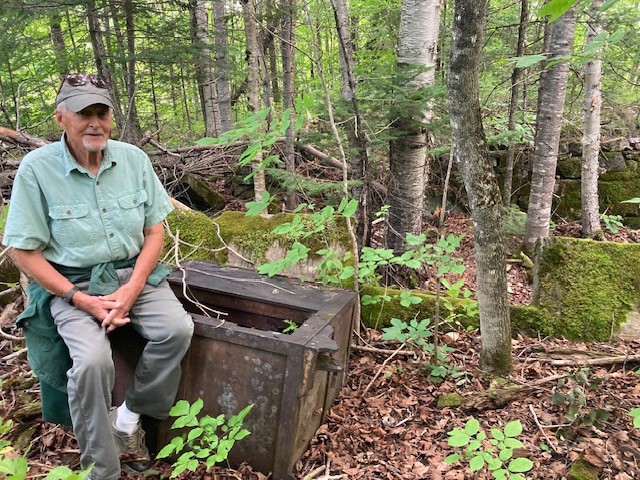
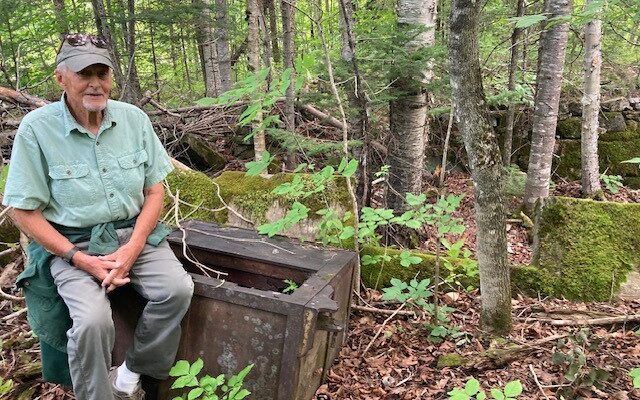
LEFT BEHIND — V. Paul Reynolds with an old safe that was not far from the old Davidson Railway depot.
For me, the most unsung but fascinating Maine ghost town is the logging community of Davidson, which was a bustling factory town in a remote location west of Staceyville on the Penobscot County line.
Founded in 1901 by Houlton banker Ora Gilpatrick and situated alongside the B&A Railroad track, the community was a remote but thriving town in the early 1900s. At its peak, with a population of over 2,000, the town boasted a clothes pin factory and a big sawmill, as well as a general store, a blacksmith shop, private homes, a church, a dance hall, streets with wooden sidewalks, a boarding home and a church.
Davidson’s founder, Gilpatrick owned the entire township and financially underwrote the construction of the entire town. Since many towns like this were named after the lumber barons who bankrolled them, nobody knows why Davidson was not named after Gilpatrick. The history behind the town’s name remains a mystery today.
Sadly, the town died in 1929, another victim of the stock market crash. Thinking back it must have been a melancholy if not traumatic time for the townspeople whose lives and livelihoods were so suddenly and harshly uprooted by this seismic national economic event.
What could it have been like back then? Thanks to a self-published book by Nina “Ollie” Way Lord, a woman from Hersey who grew up in Davidson, the story is told. The book is titled “Ollie’s Davidson”.
Here is an excerpt, “We used to live near Houlton,” he began. “I worked for farmers and did some carpentry. We have been here four years. Steady work was scarce and this sounded like a good place to live and work. In many ways we have found it good. The Gilpatricks expect a man to do a good day’s work, no loafing. The pay isn’t big but as good as anywhere. You can keep hens, a pig or two, make a garden and have all the apples and berries you want to pick. There’s a better school than most towns, and children can play anywhere. Vickey likes the neighbors better than any other place she has lived. She says, “They are real home folks.”
Even today, Maine is not immune to the economic downturns that produced our ghost towns. Maine has a surprising number of communities that aren’t true ghost towns like Davidson or Perkins Township, but are “shadow towns” — places that once had thriving populations, schools, stores, churches and industries that have largely disappeared. The causes vary from the collapse of the logging era and railroads to mill closures and Big Agriculture. Ironically, too, better highways have led to more centralized shopping habits and the closure of small town retail outlets.
While the traditional industries declined, outdoor recreation — hunting, fishing, paddling, hiking and snowmobiling — has become one of the few sectors bringing new visitors and income into many rural Maine towns. It has not fully replaced the old economies, but in some communities it has helped keep local businesses alive where mills and railroads once did.
The author is editor of the Northwoods Sporting Journal. He is also a Maine Guide.