Fish kill on the West Branch
By V. Paul Reynolds
For the second time in three years, a system failure July 27 at the McKay Power Station just below the Ripogenus Dam on the West Branch of the Penobscot River resulted in a major draw down of water levels and a major fish kill at the fabled cold water salmon fishery.
Reportedly, there was a transmission line failure and a “trip event” that shut down the McKay Station turbines. This caused an abrupt reduction of the river’s water flow from 2,400 cubic feet per second to 450 cfs. The sudden drop in water levels killed a yet to be determined number of salmon. Unofficially, 39 juvenile salmon were found dead below the power station.
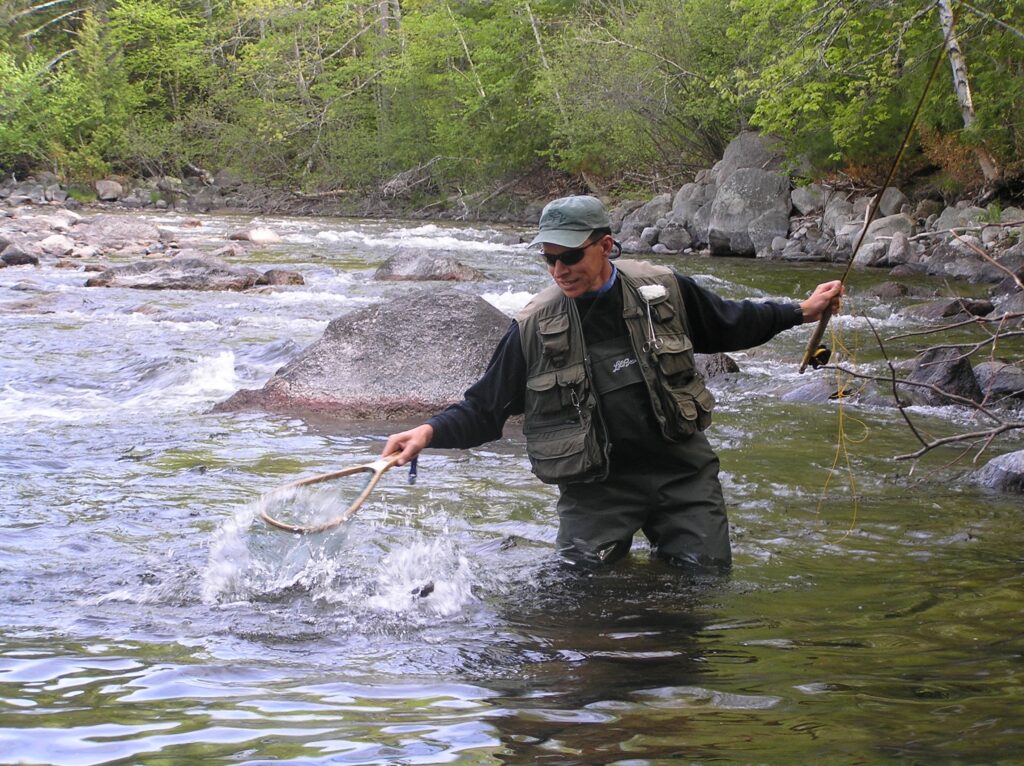
FABLED FISHERY — The West Branch of the Penobscot River below Ripogenus Lake is a fabled landlocked salmon sport fishery.
Fishing guide Todd Mercer told the Bangor Daily News that 8 to 10 feet of shoreline had been exposed at the Big Eddy. Retired fisheries biologist Neal Hagstrom estimates that when all is said and done the total fish kill will range from 3,800 to 7,700 juvenile salmon! Steve Heinz, a spokesman for Trout Unlimited, said that more needs to be done to prevent such events in the future. TU has long argued that Brookfield Energy, owner of the power station, needs improved infrastructure and better staffing to ensure faster reaction times when there is a turbine shutdown. This last turbine shutdown event lasted more than two hours before water levels were restored.
When a cross arm on a power pole of the transmission line it triggered sparks that ignited the ground brush beneath the transmission line. Volunteer campers from the Big Eddy Campground help contain the ground fires until firefighters arrived on the scene.
Fish advocates have long argued publicly and as stakeholders in the energy firm’s dam renewal applications that Brookfield Energy could do more to protect the cold water fishery in the event of an emergency draw down of the river. The power station’s unexpected outage plan allows for a water flow of 400 cfs in such sudden shutdowns of the turbines. The issue with regard to fish survival seems to be focused on the time of the outage as much as the water levels. Critics argue that better staffing at the McKay Station could significantly reduce the time required to restore the water flow, and perhaps save more fish.
According to Regional Fisheries Biologist Jeff Bagley, the Maine Department of Inland Fisheries and Wildlife is investigating the shutdown and its impact on the West Branch fishery.
Sources indicate that a letter from Maine sport fish advocacy groups has been sent to the Federal Energy Regulatory Commission to investigate whether Brookfield’s flow management adequately protects the West Branch fishery.
According to the Bangor Daily News, another fabled Maine sport fishery, the Magalloway River in the Rangeley region, was also involved recently in another water flow issue when Brookfield Energy shut down a turbine on that river’s dam.
When asked to comment, fishing guide Rich Yvon, who is also chair of the Maine Fish Coalition, takes the long view. He says, “The dam has been mismanaged and the dam itself is antiquated. As far as the big picture goes, I would like to see all the dams removed in the state. This must be done and coordinated with the introduction and commissioning of nuclear power plants. Hydro power does not count for a very much of our power demand. I would like to see our leadership addressing this issue with intelligence and common sense. The dam is a compromise and needs to be decommissioned.”