Maine wants to end emerald ash borer quarantine
By Maine Public
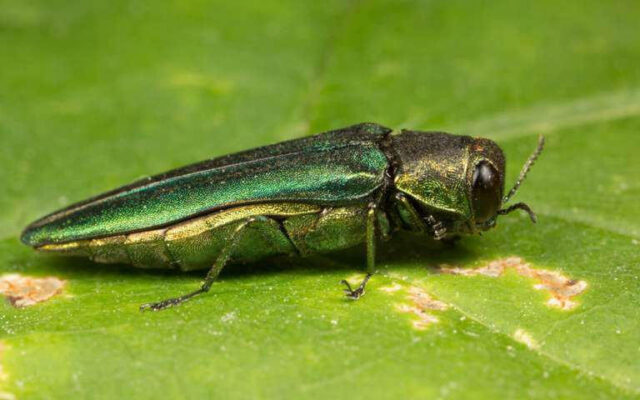
Maine officials want to eliminate quarantine rules imposed to stop the spread of invasive emerald ash borer, arguing that the destructive beetle has continued to spread despite restrictions.
“The reality is that we knew all along that it would come to this eventually, that there was no way for us to stop it,” State Horticulturist Gary Fish, with the Maine Department of Agriculture, Conservation and Forestry, said.
“All we could do is slow it down and we’ve probably slowed it down as much as we can,” Fish added.
The discovery of ash borer in the small Aroostook County town of Benedicta this April effectively linked the major infestation in southern Maine with a smaller one around Madawaska in far northern Maine, according to the department.
Emerald ash borer was discovered in Maine in 2018 and quarantine rules were enacted the next year. The regulations banned transporting most timber and all firewood outside the quarantine zone.
Despite those restrictions, the invasive beetle has spread rapidly across the state, threatening its population of native ash trees. Large numbers of beetles tunnel into live wood and can kill a tree in less than five years, according to the department.
Fish says that moving infested firewood is believed to be the prime cause of the spreading problem.
Instead of regulation, the state intends to put energy into education and to track the invasive spread.
“I mean, it is kind of like giving up to some degree,” Fish said.
“But not really, because we will continue to do the best that we can to keep track of where it is, so we can make people aware of how close it is to their stand of ash that they might want to protect or harvest or do something to further slow down the infestation,” Fish said.
The department is accepting public comments on its proposal through Aug. 28 and will hold two public hearings on the plan in Old Town and Presque Isle on Aug. 18.
This story appears through a media partnership with Maine Public.