
Drone video shows diver recovering snowmobile that fell through lake ice
By Susan Bard, Bangor Daily News Outdoors Editor
A drone video captured a diver recovering a snowmobile March 13 from beneath the ice of North Twin Lake in Piscataquis County, a week after the sled broke through.
The machine went down near Indian Point Island, not far from the Russell Point trail access. Two other snowmobiles also recently went into open water in the same area while traveling at night. No one was injured.
“If you are entering North Twin Lake from the Russell Point trail, do not turn left and head toward Indian Point Island. Stay right and follow the marked trail toward South Twin Lake and 5 Lakes Lodge,” the Jo-Mary Riders Snowmobile Club warned in a Facebook post.
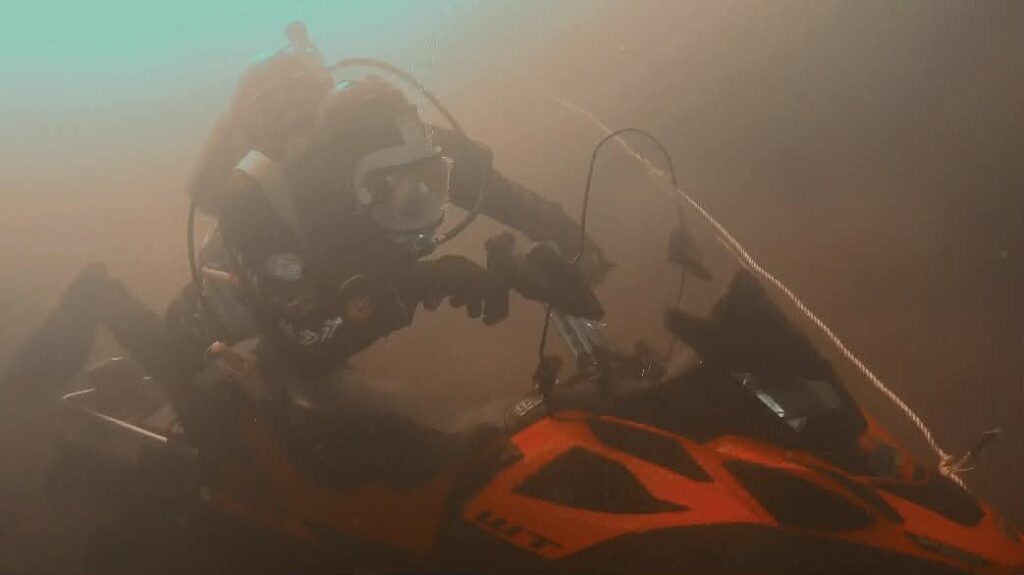
RECOVERY EFFORT — A diver works to secure a snowmobile that fell through the ice on North Twin Lake.
Two of the machines were recovered last week in shallow water. The sled shown in the video had sunk deeper — about 14 feet below the surface — requiring a diver to retrieve it.
The diver, 72-year-old Greg Canders of Canders Diving Service, recovered the snowmobile while Jason Smith helped locate it and filmed the operation using a Fifish V6 Expert underwater drone.
At one point during the recovery, Canders had some fun pretending to ride the sled wide open and jokingly pulled the snowmobile’s starter cord while it was still underwater.
“I tried to start it but I think she’s a little flooded,” he said.
The team used inflatable airbags to lift the sled — the same method used to recover a plane that crashed into Moosehead Lake.
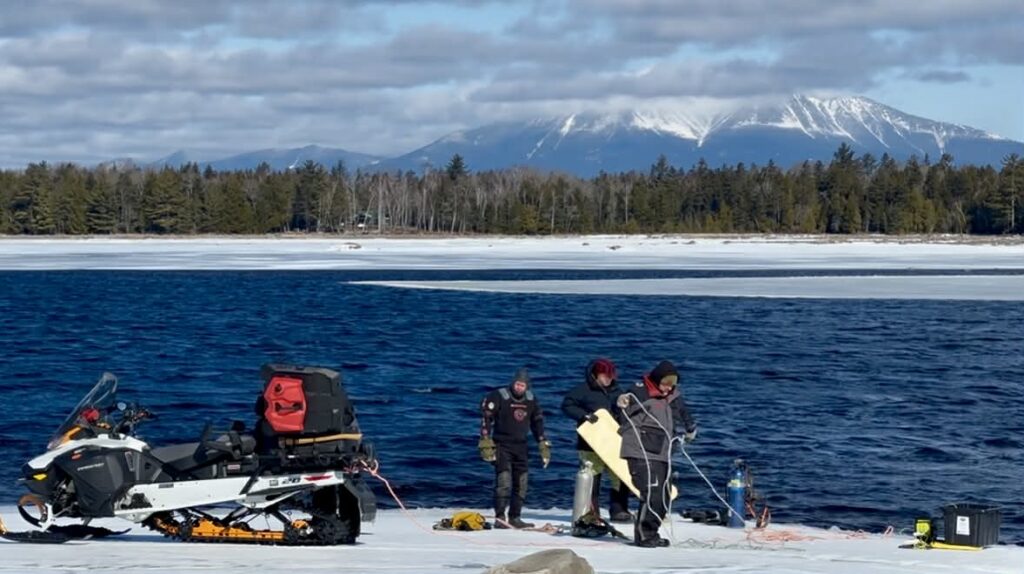
GETTING READY — Diver Greg Canders and members of the recovery team prepare to enter North Twin Lake to retrieve a snowmobile that fell through the ice near Indian Point Island.
Ice conditions in the area have been changing rapidly, Smith said. The narrows between sections of the lake already had open water, and a recent warm spell caused the opening to widen significantly, making the recovery more challenging.
Riders are urged to stay on clearly marked trails and check local snowmobile club Facebook pages for updates, particularly after last week’s temperatures climbed above 70 degrees, which can quickly weaken ice.
Mark Latti, spokesman for the Maine Department of Inland Fisheries and Wildlife, said this time of year the quality of the ice is often more important than its thickness.
“As temperatures warm, the sun gets higher and days get longer, ice quality begins to deteriorate and it cannot support the same amount of weight it could when temperatures were colder,” Latti said.
When asked about a separate incident this past weekend in which a truck went through the ice on Moosehead Lake, Latti said the department never recommends driving trucks onto lake ice.
“That is a personal decision,” he said. “We recommend that people always check the ice before venturing out onto any water and then decide whether it can support them and whatever they bring, whether it’s a sled full of ice fishing gear, a snowmobile, a side-by-side or any other equipment.”
Latti said warming temperatures and rain can quickly weaken late-season ice, especially near currents, springs and shorelines where rising water can cause ice to pull away from land. Exposed rocks and holes in the ice — whether natural or from ice fishing — can also weaken surrounding areas.