We drove onto the ice. Seconds later, the truck sank
By Al Raychard
I remember the day like it was yesterday — the day we drove a truck onto the ice and nearly lost it.
A few years ago, a buddy called and asked if I wanted to go ice fishing the next day. I’m not a big winter angler but it was the middle of March and we were in a late-winter heat wave with daytime temperatures in the low 50s. It sounded like a nice way to spend the day, so I agreed to go.
After picking me up the next morning, we drove to a nearby lake. Pulling onto the beach, you could see where vehicles and snowmobiles had driven onto the ice during the winter. There was still some snow on the lake but where it had melted the ice looked gray. Along the shoreline and in a nearby cove I could also see standing water.
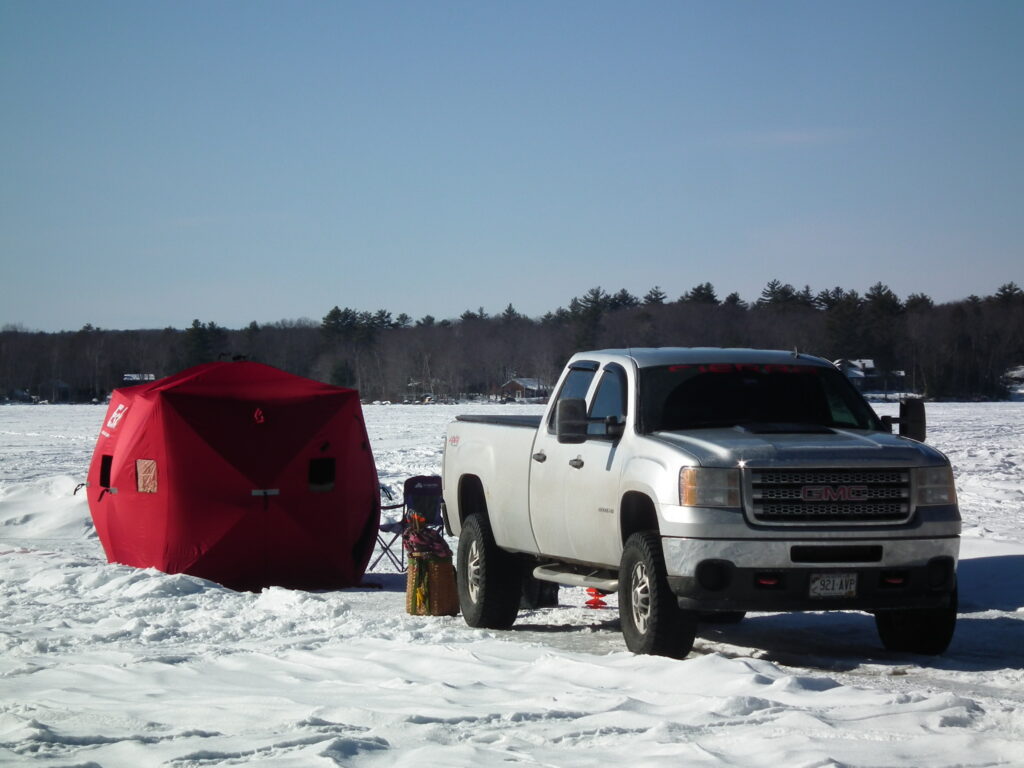
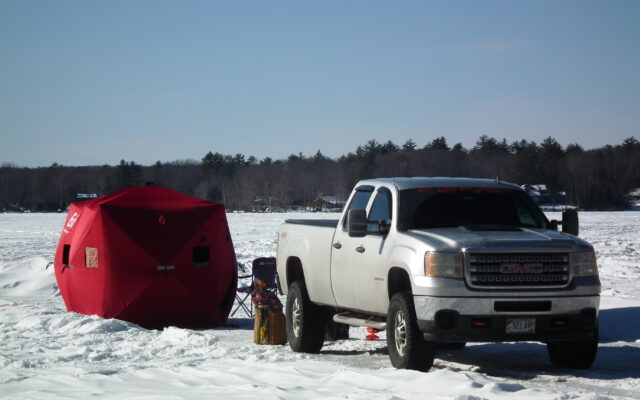
TRUCK ON THE ICE — Driving pickups on lake ice is never a good idea, especially in March when ice conditions can change quickly.
“You sure the ice is still safe enough to drive on?” I asked.
“Oh sure. I was here last weekend and there was plenty of ice.”
Famous last words.
As we drove onto the ice and got only a few feet from shore, the front end of the truck suddenly dropped. It was like hitting a stone wall. The truck stopped with a violent jolt.
During the summer the pond we had just driven onto is a popular swimming spot because the bottom slopes gradually. About 50 yards from shore, the water is less than chest deep. Closer to shore, it barely reaches your knees. When the ice broke, the front tires hit bottom while the rear of the truck was still on shore.
After rocking the truck back and forth, breaking more ice and finally getting some traction, the four-wheel drive pulled us out. But not before seeing my life flash before my eyes and realizing the whole situation should never have happened.
We hear a lot about safe ice conditions early in the winter when lakes are first freezing. But we rarely hear much about March, when winter is on its way out. The truth is, ice conditions can change quickly at any time of year.
Even in midwinter, ice can vary from one part of a lake to another. Conditions can also differ dramatically across Maine. Ice that may be safe in Aroostook or Penobscot counties could be far weaker in Cumberland or York counties or along the Downeast coast.
When temperatures swing between warm days and cold nights, the ice expands and contracts, creating cracks and weak spots. Increasing daylight and a stronger sun can prevent parts of a lake from refreezing completely. Rain can leave standing water and slush that never hardens again.
Snow also plays a role. It acts like an insulating blanket, often leaving ice beneath it thinner and weaker. Later in the season, as the snow disappears, the sun softens the surface while warming water and lake bottoms begin melting the ice from below.
Shorelines can become especially dangerous. Rocks, exposed earth and other structures absorb heat from the sun and create thin ice or open water. The same is true where streams and brooks flow into a lake.
The bottom line is that March ice is exposed to a variety of environmental factors that make it increasingly unpredictable as the month progresses.
Since our little drive-through-the-ice adventure a few years ago, I have one cardinal rule about spring ice. I don’t trust anyone’s word when it comes to how safe it is. I trust my instincts and my eyes. If the ice looks unsafe, or if that little voice inside tells me to stay off, I stay off.
I like catching fish as much as the next guy, but I have yet to see one worth dying for.