Dover-Foxcroft Downtown Riverfront Design Open House on Jan. 25
DOVER-FOXCROFT — Dover-Foxcroft residents will have a say in what the downtown riverfront will look like in the future after the multiyear process to remove the Mayo Mill Dam on the Piscataquis River.
A Downtown Riverfront Design Open House will be held from 1-3 p.m. on Sunday, Jan. 25 in the town office meeting room, Town Manager Alsina Brenenstuhl announced during a select board meeting on Monday evening.
Attendees can stop in between 1 and 3 o’clock to ask questions of organization representatives involved in the project and provide input on the riverfront restoration process in advance of the dam removal. This is a valuable opportunity for community members to help shape the future design and use of the riverfront area.
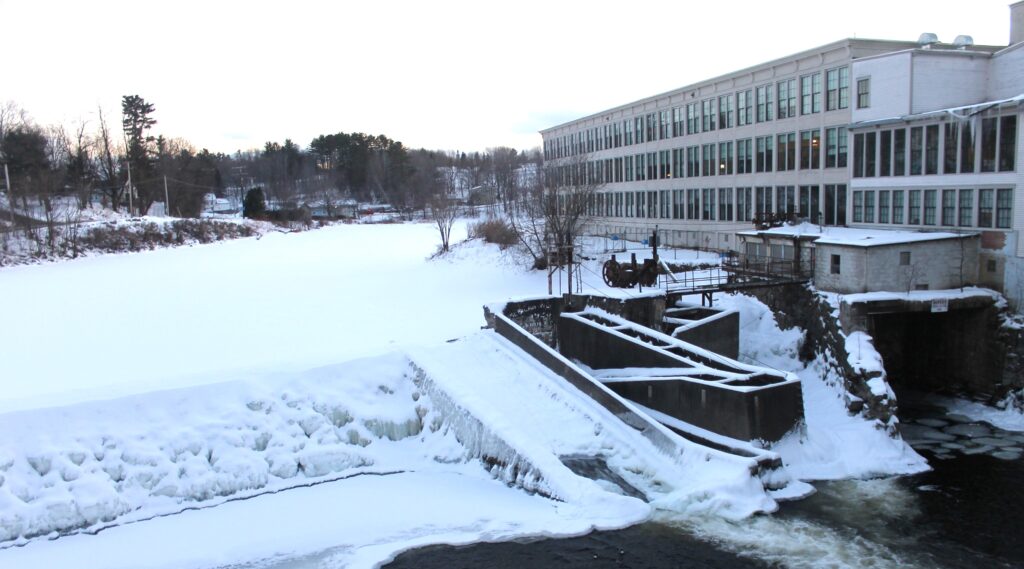
MAYO MILL DAM — A Dover-Foxcroft Riverfront Design Open House is scheduled for 1-3 p.m. on Sunday, Jan. 25 at the town office, allowing residents to have input on what the area will look like after the removal of the Mayo Mill Dam on the Piscataquis River.
“This is not the end all be all by any means, this is just preliminary,” Brenenstuhl said.
“Drop in, look around and ask questions or just use the suggestion box,” she said. “The focus is really what the riverfront is going to look like.”
After years of research, including work by two separate dam committees, last June residents voted down authorizing the select board to borrow up to $9 million for the retention and repair of the dam via a 659-297 count. The select board was given the go ahead to work with external partners to remove the Mayo Mill Dam and restore the town’s riverfront. In August, the board formalized an agreement with The Nature Conservancy and the Atlantic Salmon Federation.
The dam surrender application is scheduled to be submitted to the Federal Energy Regulatory Commission in the spring and review takes about 18-24 months.
Permitting should be complete by 2027 and then the removal project can go to bid with an eye on the summer of 2028 for work. The schedule is subject to change.
Leaving the dam as is was not an option. The structure was obtained by the town after a mill closure in 2007 and it has not complied with federal regulations for over a decade. The Federal Energy Regulatory Commission cited multiple structural deficiencies in a study. Ideas of retrofitting the dam and using it for hydroelectric power were deemed too expensive.
Had residents approved repairing the dam, the $9 million price tag would have been spread out across 25 years, with a 5% interest rate, putting the project cost at $14,107,600, including $5,107,600 in interest. The projected annual cost would have been $664,000.
In other business, Brenenstuhl proposed a new schedule for the budget advisory committee in its work on the 2026-27 finances.
Instead of having four meetings across multiple weeks in March the committee could meet for one day with the municipal department heads. A date and specific time would be determined after polling committee members, but potentially from 9 a.m. to 3 p.m. one day with the public welcome to attend.
“It’s a normal budget committee meeting, it’s just a one-day shot,” Brenenstuhl said. “Once the meeting gets rolling, I think it’s a smooth shot.”
Last year there were four meetings at two hours each, but Brenenstuhl said some time was unnecessarily spent on recapping discussions from prior weeks and some committee members needed to arrive a bit later after getting out of work.
If need be an additional budget advisory committee meeting could be held, and the group would still have a separate session with the full select board.
Selectperson Emery Cox wondered if all meeting participants would have a chance to ask questions in a one-day session. “I just want everybody to have their chance,” he said.
Without needing to spend time convening multiple meetings, such as with roll call, voting on minutes and recapping, Brenenstuhl feels there will be enough time.
After the work of the budget advisory committee, the select board votes on the budget and it is brought to the annual town meeting in late April. The total approved that Saturday is then moved to a referendum vote on the second Tuesday of June.
In open session Selectperson Jane Conroy asked about the status of naming the forthcoming replacement East Main Street bridge in honor of a pair of Dover-Foxcroft brothers who both died in service of their country in a World War II prisoner of war camp.
Last summer the select board recommended naming the future bridge for Pvt. Willard D. Merrill and Pvt. Barton G. Merrill Jr.. Bridge naming is done by the Maine Legislature after input from the Maine Department of Transportation but first approval is needed by the local town government. Resident Dave Lewis is working with area representatives in Augusta on this.
Rep. Chad Perkins, R-Dover-Foxcroft has a resolution in to the legislative transportation committee, Brenenstuhl said, with formal naming not coming until the new bridge is in place.
In June a funeral service was held at the Vaughn Road cemetery as Willard Merrill was laid to rest.
Merrill, who was 21 when he died, was among the U.S. and Filipino soldiers captured by the Japanese Imperial Army after the surrender of the Bataan Peninsula on April 9, 1942.
After his capture Merrill was one of 78,000 prisoners who endured the 65-mile Bataan Death March, which began the next day. Thousands of prisoners died during the march.
Merrill was held at the Cabanatuan POW camp, where he died on Nov. 14, 1942, and was buried in a common grave, the Defense POW/MIA Accounting Agency said.
Despite several efforts over the years, his remains were not identified until recently. They were flown back to Logan Airport in Boston where a three-state police escort to Dover-Foxcroft began.
The Merrill family had three brothers go to war and only one returned. Willard and Barton Merrill Jr. joined the U.S. Army Air Corps together, fought side by side, survived the Bataan Death March in the spring of 1942 and died a day apart in a Japanese POW camp later that year. Barton Merrill Jr.’s remains were identified and he is buried in Manilla.
The family is hoping Barton Merrill Jr. can also be brought home to join his brothers.
Bridge replacement is in the beginning stages. A new overpass would be in place in three or four years at the earliest. Construction would need to be coordinated with removal of the nearby Mayo Mill Dam.